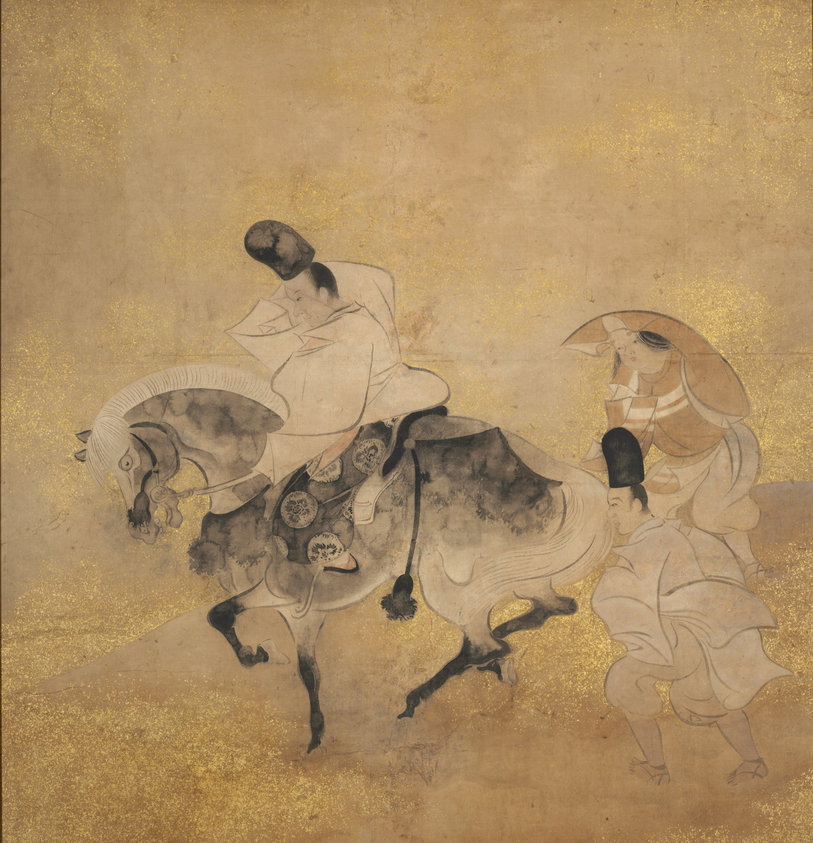
Crossing at Sano
Tawaraya Sōtatsu (workshop)
Like many paintings from the Sōtatsu studio, a Kyoto-based atelier that ran the shop Tawaraya, this one is done in ink, mineral colors, and gold, and is formally reminiscent of 12th- and 13th-century paintings associated with the Japanese aristocracy. It depicts a man on horseback with two attendants crossing a bridge that once spanned the Kino River in Sano in eastern Wakayama Prefecture. The composition was inspired by a poem by Fujiwara no Teika (1162–1241) that translates as follows: I stop my horse, but there is no shelter as I brush off my sleeves at Sano Crossing in the evening snow.
Colors in this work
Details
- Date
- c. 1600–1640
- Dimensions
- overall: height 1.617 m, width 1.392 m, depth 0.463 m; diameter of base: width 0.463 m; painting only: height 1.259 m, width 1.214 m; with frame: height 1.519 m, width 1.301 m, depth 0.032 m
- Department
- Japanese Art
- Holding institution
- Cleveland Museum of Art
- Palette
-
Select a color to find related artworks.
- Image provider
- cleveland-museum-of-art
- License
- CC0-1.0
- Credit
- John L. Severance Fund
Art Genome Taxonomy
12 tags
Subject Matter
-
Equestrian Both · 99%
The catalog describes a man on horseback with attendants, and the image clearly shows mounted and equestrian figures with horses.
-
Animals Visual · 98%
Two horses and several human figures are visibly depicted across the composition.
-
Human Figure Visual · 98%
The image visibly contains several human figures, including a central mounted figure and accompanying attendants.
-
Movement Visual · 93%
The horses’ extended legs, overlapping bodies, and directional arrangement create a clear sense of travel and movement.
-
Narrative Metadata · 93%
The museum identifies the work as a scene of a crossing at Sano and states that its composition was inspired by a poem by Fujiwara no Teika.
Visual Qualities
-
Contour Line Visual · 95%
Economical ink contour lines define the figures, horses, garments, bridles, and other equipment.
-
Glittery Visual · 94%
A broad field of visibly reflective, irregularly speckled gold surrounds the figures and horses.
-
Sparse Visual · 90%
The figures occupy a relatively limited area within a large, open gold field, producing a sparse overall composition.
Medium and Techniques
-
Painting Metadata · 99%
The museum classifies the object as a painting and identifies its medium as ink, color, and gold on paper.
-
Work on Paper Metadata · 98%
The catalog identifies the support as paper and describes the work as ink, color, and gold on paper.
-
Hanging Scroll Metadata · 99%
The museum identifies the object as a hanging scroll mounted as a single-panel screen.
Materials
-
Gold Both · 99%
Gold is visibly present throughout the ground, and the catalog explicitly lists gold as part of the medium.
Source & rights
Tawaraya Sōtatsu (Japanese, c. 1570–c. 1640). Crossing at Sano. Cleveland Museum of Art.
High-resolution sources
- Original TIFF ↗ 5,563 × 5,772 · Cleveland Museum Of Art · Available