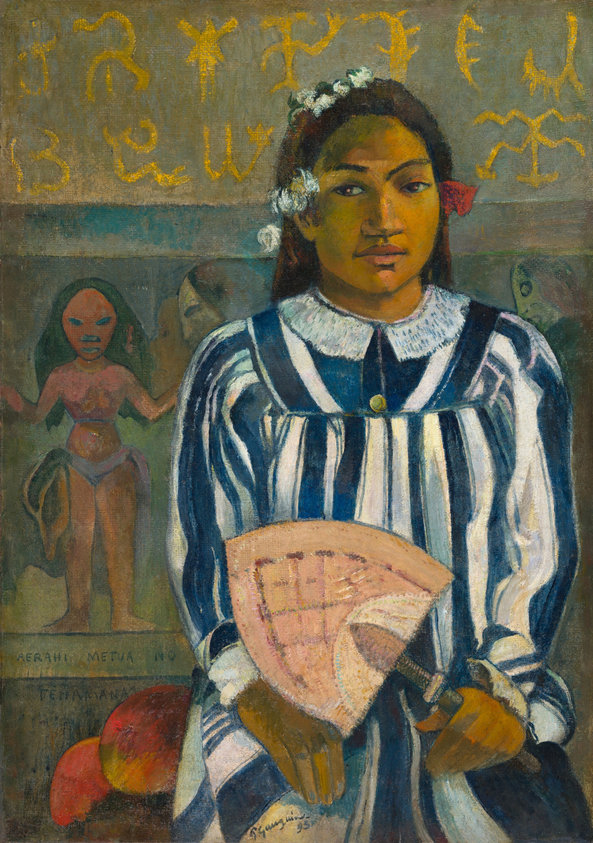
Merahi metua no Tehamana (Tehamana Has Many Parents or The Ancestors of Tehamana)
In this portrait, Gauguin depicts the 13-year-old Tahitian girl Tehamana in a missionary dress holding a Samoan fan. A ripe mango alludes to fertility. In the background, Gauguin combined various non-European emblems—glyphs derived from an Easter Island tablet and a female deity inspired by Polynesian and Hindu sources—to build a generic sense of foreignness, transforming Tehamana into the embodiment of his own imagination.
Colors in this work
Details
- Artist
- Paul Gauguin
- Date
- 1893
- Medium
- Oil on jute canvas
- Dimensions
- 75 × 53 cm (29 1/2 × 20 7/8 in.); Framed: 98.8 × 76.6 × 8.3 cm (38 7/8 × 30 1/8 × 3 1/4 in.)
- Origin
- France
- Department
- Painting and Sculpture of Europe
- Holding institution
- Art Institute of Chicago
- Palette
-
Select a color to find related artworks.
- Image provider
- art-institute-chicago
- License
- CC0-1.0
- Credit
- Gift of Mr. and Mrs. Charles Deering McCormick
Art Genome Taxonomy
11 tags
Subject Matter
-
Individual Portrait Both · 99%
A single, specifically identified sitter occupies the composition, and the museum classifies the work as a portrait.
-
Adolescence Both · 98%
The museum identifies Tehamana as 13 years old, while the image presents a visibly young female sitter.
-
Face Visual · 99%
The sitter’s face is a primary visual focus, shown frontally with a direct, steady gaze.
-
Fertility/Pregnancy/Birth Metadata · 90%
The canonical museum description states that the ripe mango beside Tehamana alludes to fertility.
-
Flora Both · 99%
White flowers are visibly arranged in the sitter’s hair, and flowers are listed among the cataloged subjects.
-
Food Both · 98%
Several fruits are visible at the lower left, and the catalog identifies fruit, including a ripe mango, as part of the subject matter.
-
Text Both · 98%
Gold glyph-like marks and painted lettering are visible in the background and lower-left area; the catalog describes glyphs and lists text among the subjects.
-
Deities and Holy Figures Metadata · 95%
The museum identifies a background female figure as a deity inspired by Polynesian and Hindu sources.
Styles and Movements
-
Post-Impressionism Both · 97%
The canonical metadata identifies the style as Post-Impressionism, and the image shows flattened forms, saturated color areas, and emphatic painterly handling consistent with that classification.
Medium and Techniques
-
Oil Painting Both · 99%
The work is visibly an oil painting, and the canonical metadata identifies the medium as oil on jute canvas.
Time Periods
-
Late 19th Century Art Metadata · 99%
The work is dated 1893 in the canonical metadata, placing it in the late nineteenth century.
Source & rights
Paul Gauguin. Merahi metua no Tehamana (Tehamana Has Many Parents or The Ancestors of Tehamana). The Art Institute of Chicago.
High-resolution sources
- IIIF image service ↗ 1,686 × 2,398 · Art Institute Chicago · Availability not yet probed