Ivy Lane
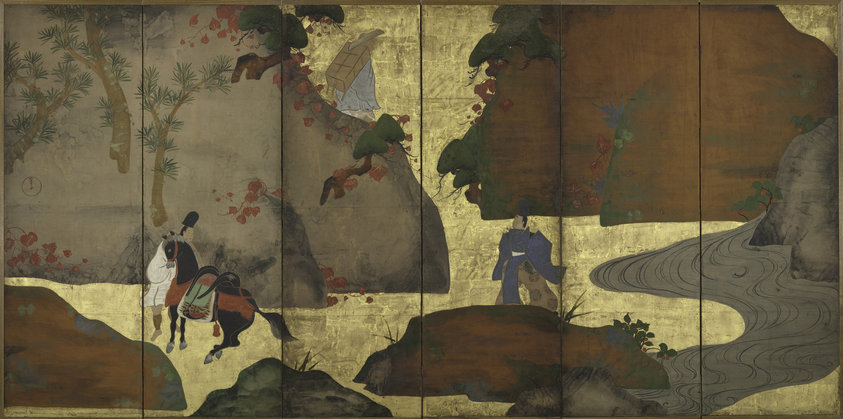
In an episode from the tenth-century literary classic The Tales of Ise, a courtier happens upon a Buddhist priest on an ivy-covered pass on Mount Utsu, a Japanese homonym for “Melancholy Mountain.” He entrusts the priest with a letter to a former lover in the capital whom he laments he can no longer see, even in dreams. The Tales of Ise features poems set within a basic narrative of the journeys of a courtier in exile.
Colors in this work
Details
- Date
- 1700s
- Dimensions
- image: height 1.331 m, width 2.676 m; overall: height 1.365 m, width 2.71 m; closed: height 1.356 m, width 0.463 m, depth 0.11 m; panel: height 1.331 m, width 0.446 m
- Department
- Japanese Art
- Holding institution
- Cleveland Museum of Art
- Palette
-
Select a color to find related artworks.
- Image provider
- cleveland-museum-of-art
- License
- CC0-1.0
- Credit
- John L. Severance Fund
Art Genome Taxonomy
12 tags
Subject Matter
-
Landscapes Both · 99%
The image presents a broad natural setting of rocks, trees, a mountain route, and a stream; the catalog situates the scene on an ivy-covered pass on Mount Utsu.
-
Waterscapes Visual · 98%
A large winding stream with repeated curving lines occupies the right side of the screen.
-
Flora Both · 96%
Trees and trailing vine-like foliage are prominent in the image, and the catalog specifically describes the pass as ivy-covered.
-
Human Figure Visual · 99%
The composition visibly includes a mounted figure and a standing figure within the landscape.
-
Narrative Metadata · 98%
The museum describes the work as an episode from the tenth-century literary classic The Tales of Ise, involving an encounter and the delivery of a letter.
-
Related to Literature Metadata · 96%
The catalog identifies the subject as an episode from The Tales of Ise, a literary classic.
Medium and Techniques
-
Painting Metadata · 99%
The museum classifies the work as a painting and describes it as a six-panel folding screen painted with ink and color on gilded paper.
-
Screen Format Metadata · 99%
The catalog explicitly identifies the object as a six-panel folding screen.
-
Gold Leaf and Gilding Both · 99%
The image has a visibly luminous metallic ground, while the catalog specifies ink and color on gilded paper.
Time Periods
-
18th Century Art Metadata · 99%
The work is dated 1720–1757, placing it within the eighteenth century.
Geographic Regions
-
Japanese Art Metadata · 99%
The catalog identifies the place of origin as Japan and the period as Edo.
Cultural and Religious Styles
-
Edo Art Metadata · 98%
The catalog identifies the work as Japanese art from the Edo period (1615–1868).
Source & rights
Fukae Roshū (Japanese, 1699–1757). Ivy Lane. Cleveland Museum of Art.
High-resolution sources
- Original TIFF ↗ 12,837 × 6,373 · Cleveland Museum Of Art · Available