"He Turned Their Waters into Blood"
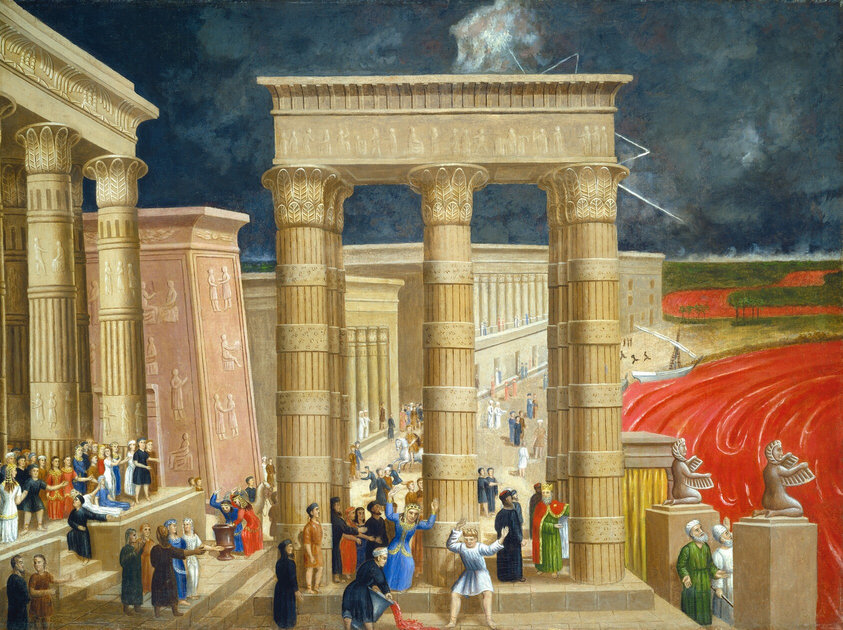
Dozens of light-skinned men and women gather around clusters of columns and sandstone-colored buildings that line a crimson-red river to our right in this horizontal painting. The center of the painting is dominated by a structure made up of three rows of three columns each, which hold up a flat-topped roof. A similar structure angles into the distance along the left edge of the painting. The columns of these two structures are carved with bands showing people separated by rings of vertical lines. The capitals are carved with stylized leaves. Just beyond the columns to our left, a blocky, rose-pink structure is carved with more people, seated or standing singly or in pairs. More rectangular, parchment-brown buildings extend into the distance along the water’s edge. The people gathered along the riverbank wear robes and tunics in deep blue or black, bright white, or saturated tones of cobalt blue, ruby red, or shell pink. Standing within the columns of the central structure, a crowned, bearded man wearing an emerald-green robe under a scarlet-red cloak gestures to our right, toward the red river. A woman nearby, wearing lapis blue and also crowned, watches with hands flung up as a person pours red liquid from a bucket. Most of the other people look or gesture toward the river, which winds in deep S-curves from the horizon line, which comes about two-thirds of the way up the composition, through sage-green fields, to the town. A single, white lightning bolt zigzags down from a white cloud in an otherwise navy-blue sky above.
Colors in this work
Details
- Artist
- Erastus Salisbury Field
- Date
- c. 1865/1880
- Medium
- oil on canvas
- Dimensions
- overall: 76.8 x 102.9 cm (30 1/4 x 40 1/2 in.) framed: 95.2 x 121.9 x 6.3 cm (37 1/2 x 48 x 2 1/2 in.)
- Department
- CAB
- Holding institution
- National Gallery of Art
- Palette
-
Select a color to find related artworks.
- Image provider
- national-gallery-of-art
- License
- CC0-1.0
- Credit
- Gift of Edgar William and Bernice Chrysler Garbisch
Art Genome Taxonomy
8 tags
Subject Matter
-
Bible Story Both · 98%
The title identifies a biblical event, while the image presents a dramatic communal response to a river rendered crimson.
-
Crowds Visual · 99%
Numerous figures occupy the steps, colonnades, streets, and riverbank in several clustered groups.
-
Water Visual · 99%
A broad crimson river is a dominant feature on the right side of the composition.
-
The Elements Visual · 99%
A dark storm sky contains a sharply defined white lightning bolt and cloud.
Visual Qualities
-
Dense Composition Visual · 98%
Overlapping architecture, numerous figures, receding structures, steps, and the river create a crowded composition.
-
Bright and Vivid Colors Visual · 90%
The painting contrasts deep navy and black with saturated crimson, cobalt blue, emerald green, shell pink, white, and ochre.
Medium and Techniques
-
Oil Painting Metadata · 99%
The catalog identifies the medium as oil on canvas.
Time Periods
-
19th Century Art Metadata · 99%
The catalog dates the work to c. 1865/1880, placing it within 19th-century art.
Source & rights
Erastus Salisbury Field. "He Turned Their Waters into Blood". Courtesy National Gallery of Art, Washington.
High-resolution sources
- IIIF image service ↗ 6,675 × 4,983 · National Gallery Of Art · Available