Paulownias and Chrysanthemums
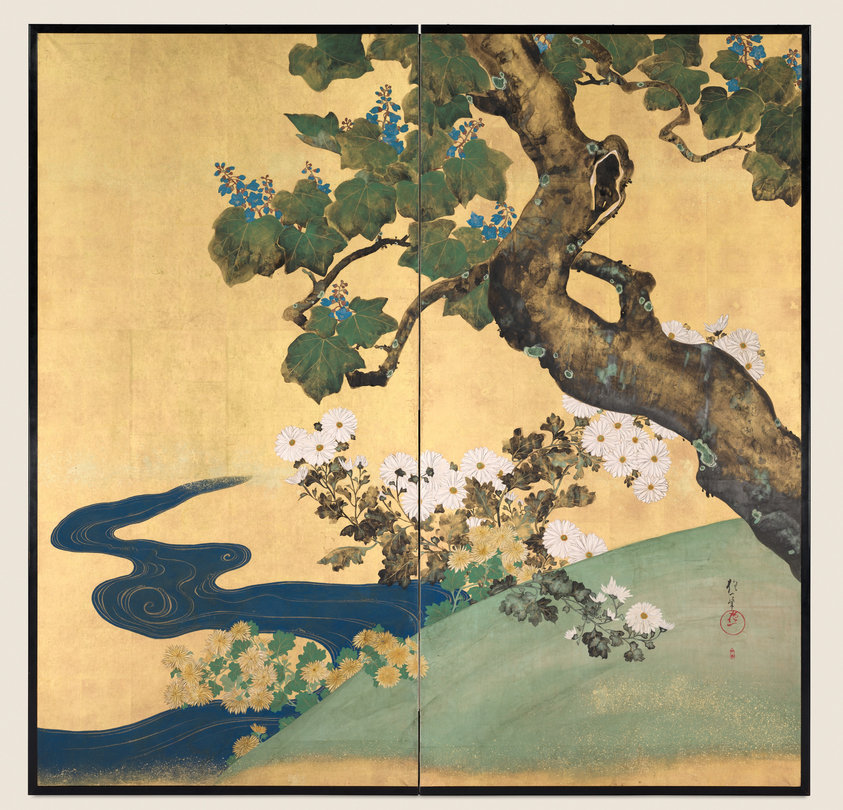
In this screen, Sakai Hōitsu expertly deployed a painting technique called “dripping-in” (tarashikomi). Ink and color dripped on the surface, and allowed to pool there, created the illusionistic effect of lichen-dotted tree bark and twisted chrysanthemum leaves. Paulownia and chrysanthemum are signifiers of late spring and early autumn as well as emblems of the Japanese imperial house. Paulownia also has medicinal properties and associations with fortitude, while chrysanthemum symbolizes good government.
Colors in this work
Details
- Date
- early 1800s
- Dimensions
- image: height 1.527 m, width 1.549 m; overall: height 1.575 m, width 1.585 m
- Department
- Japanese Art
- Holding institution
- Cleveland Museum of Art
- Palette
-
Select a color to find related artworks.
- Image provider
- cleveland-museum-of-art
- License
- CC0-1.0
- Credit
- Gift of the American Foundation for the Maud E. and Warren H. Corning Botanical Collection
Art Genome Taxonomy
12 tags
Subject Matter
-
Flora Visual · 99%
Paulownia foliage and numerous white and yellow chrysanthemum blossoms are prominent throughout the composition.
-
Water Visual · 98%
A stylized dark-blue stream with curling linear accents winds across the lower-left and lower-center areas.
-
Symbolic Composition Metadata · 90%
The museum describes the paulownia and chrysanthemum as seasonal signifiers and emblems of the Japanese imperial house, with additional associations of fortitude and good government.
Visual Qualities
-
Asymmetrical Visual · 99%
The main trunk and foliage are concentrated on the right while a broad gilded field remains open on the left.
-
Dark Colors Visual · 90%
Dark brown-black branches and deep green foliage contrast sharply with the pale gold ground and light-colored flowers.
Medium and Techniques
-
Painting Metadata · 100%
The Cleveland Museum of Art classifies the work as a painting and records it as a two-panel folding screen in ink and color on gilded paper.
-
Work on Paper Metadata · 100%
The recorded medium is ink and color on gilded paper, supporting its classification as a work on paper.
-
Gold Leaf and Gilding Metadata · 98%
The museum describes the support as gilded paper, and the image visibly shows a luminous gold-toned ground.
-
Stains/Washes Both · 80%
The bark and leaves show pooled, mottled passages consistent with the museum’s description of tarashikomi, or “dripping-in”; stains and washes are the closest available catalog technique category.
Time Periods
-
19th Century Art Metadata · 99%
The work dates to the early 1800s, within the nineteenth century, and the catalog places it in Japan’s Edo period.
Geographic Regions
-
Japanese Art Metadata · 100%
The catalog identifies the place of origin as Japan and lists Japanese Art among the classifications.
Cultural and Religious Styles
-
Edo Art Metadata · 99%
The catalog identifies the work as originating in Japan during the Edo period (1615–1868).
Source & rights
Sakai Hōitsu (Japanese, 1761–1828). Paulownias and Chrysanthemums. Cleveland Museum of Art.
High-resolution sources
- Original TIFF ↗ 8,347 × 8,012 · Cleveland Museum Of Art · Available