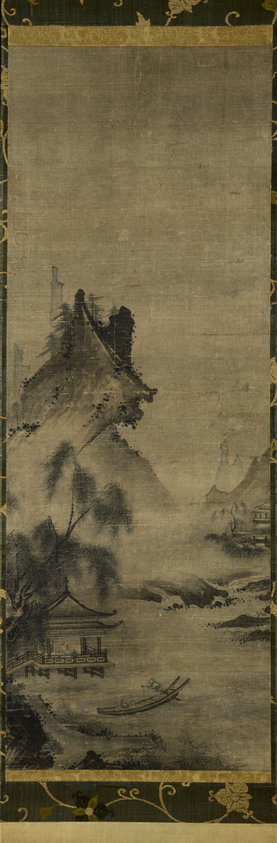
Lakeside Retreat
This scroll makes clear the rich visual diversity of ink painting outside metropolitan Kyoto. These Kanto region paintings are generous in size, as well as in their visions of imagined foreign scenery. They are similarly composed: foreground expanses of water give way to clouds and bands of mist in middle distance, concealing the bases of the towering peaks, marking the transition in compositional space in both vertical and far distances. These mountain forms dominate the landscape vision as they echo and fill the narrow confines of this traditional hanging scroll format of the Muromachi era. A particular allure of this painting lies precisely in its classical setting highlighted with assertive tonal values in ink washes, dotting strokes, and dotting clusters with the more rustic-but in the Japanese view "natural"-elements of bamboo groves, brushwood fences, grass-roofed huts, and gentle, lowland streams nearby. These are traits linked to 15th-century Korean suibokuga (ink paintings) favored by the many clerics of 15th-century Kyoto and Kamakura. The artist rendered the subject through the filter of 15th-century Korean painting rather than classical Chinese painting. He may even have been a Korean monk-painter resident in one of Kyoto's Zen temples, as many were in the 15th century.
Colors in this work
Details
- Artist
- Unknown artist
- Dimensions
- overall: height 1.188 m, width 0.434 m
- Department
- Japanese Art
- Holding institution
- Cleveland Museum of Art
- Palette
-
Select a color to find related artworks.
- Image provider
- cleveland-museum-of-art
- License
- CC0-1.0
- Credit
- Gift from the Collection of George Gund III
Art Genome Taxonomy
10 tags
Subject Matter
-
Landscapes and Waterscapes Both · 99%
The image presents an extensive mountain-and-water environment, and the museum catalog identifies foreground water, mist-covered middle distance, towering peaks, and lowland streams.
-
Water Both · 98%
Water occupies the lower and middle portions of the composition, including a broad expanse around the pavilion and a small boat; the catalog specifically describes foreground expanses of water and nearby streams.
-
Haze Both · 98%
Pale passages and diluted tonal areas visibly veil the middle distance and mountain bases, corresponding to the catalog's description of clouds and bands of mist separating compositional zones.
-
Engaged with Traditional Korean Art Metadata · 84%
The catalog links the painting's traits to 15th-century Korean suibokuga and states that the subject was rendered through the filter of 15th-century Korean painting rather than classical Chinese painting.
Medium and Techniques
-
Hanging Scroll Both · 99%
The work is cataloged as a hanging scroll, and the image visibly shows a tall, narrow scroll format with textile mounting.
-
East Asian Ink-and-Wash Painting Both · 98%
The museum identifies the medium as ink and color on silk, while the image shows tonal ink washes, clustered dotting strokes, and brush textures across the mountains, vegetation, and shorelines.
-
Long Distance and Deep Distance Both · 94%
The composition establishes recession from the pavilion and boat through a misty middle distance toward distant peaks and structures; the catalog explicitly discusses vertical and far distances.
Time Periods
-
15th Century Art Metadata · 90%
The museum dates the work to the late 1400s through the early 1500s, a range that overlaps the 15th century.
-
16th Century Art Metadata · 80%
The museum date range extends into the early 1500s, overlapping the 16th century.
Geographic Regions
-
Japanese Art Metadata · 99%
The Cleveland Museum of Art identifies the place of origin as Japan and the work as Japanese Art from the Muromachi period.
Source & rights
Unknown artist. Lakeside Retreat. Cleveland Museum of Art.
High-resolution sources
- Original TIFF ↗ 1,640 × 5,000 · Cleveland Museum Of Art · Available