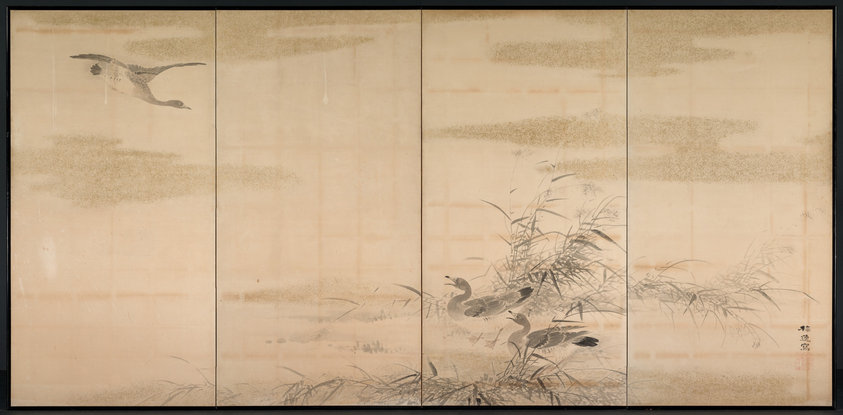
Geese, Reeds, and Water
This byōbu composition differs from most in that it comprises two four-panel screens, rather than two six-panel units. Since the current mounting is modern, it is impossible to determine whether its present configuration represents its original design. Some panels may have been removed to help the screens better fit into a modern interior space. Baiitsu worked almost exclusively in monochromatic ink tones and favored classical Chinese painting themes.
Colors in this work
Details
- Date
- 1800s
- Dimensions
- image: height 1.69 m, width 3.505 m
- Department
- Japanese Art
- Holding institution
- Cleveland Museum of Art
- Palette
-
Select a color to find related artworks.
- Image provider
- cleveland-museum-of-art
- License
- CC0-1.0
- Credit
- Bequest of Mrs. A. Dean Perry
Art Genome Taxonomy
12 tags
Subject Matter
-
Animals Both · 99%
Four geese are clearly visible in the image, and the catalog title identifies the subject as “Geese, Reeds, and Water.”
-
Waterscapes Both · 90%
The title identifies water, and the image shows reeds and pale horizontal bands suggesting a waterside environment.
Visual Qualities
-
Sparse Visual · 98%
Large pale areas separate the birds, reeds, and horizontal bands, producing a notably open composition with substantial unpainted or lightly washed space.
-
Asymmetrical Visual · 96%
The flying goose in the upper left is balanced against a denser cluster of geese and reeds toward the lower center-right, creating an uneven but controlled arrangement.
-
Earth Tones Visual · 90%
The visible palette is dominated by warm beige, gray, brown, and muted green tones.
Medium and Techniques
-
Screen Format Metadata · 99%
The catalog identifies the object as one of a pair of four-panel folding screens.
-
Painting Metadata · 99%
The catalog classification is Painting, and the listed medium includes ink and color on paper.
-
East Asian Ink-and-Wash Painting Both · 92%
The medium is ink, color, and cut gold foil on paper; the image visibly uses diluted ink washes and pale painted passages characteristic of an East Asian ink-and-wash approach.
-
Work on Paper Metadata · 99%
The catalog explicitly identifies paper as the support.
Time Periods
-
19th Century Art Metadata · 98%
The catalog dates the work to the 1800s, with date fields spanning 1800–1856.
Geographic Regions
-
Japanese Art Metadata · 99%
The work is identified as Japanese Art and its place of origin is Japan during the Edo period.
Materials
-
Gold Metadata · 96%
Cut gold foil is explicitly listed in the catalog medium description.
Source & rights
Yamamoto Baiitsu (Japanese, 1783–1856). Geese, Reeds, and Water. Cleveland Museum of Art.
High-resolution sources
- Original TIFF ↗ 15,669 × 7,712 · Cleveland Museum Of Art · Available