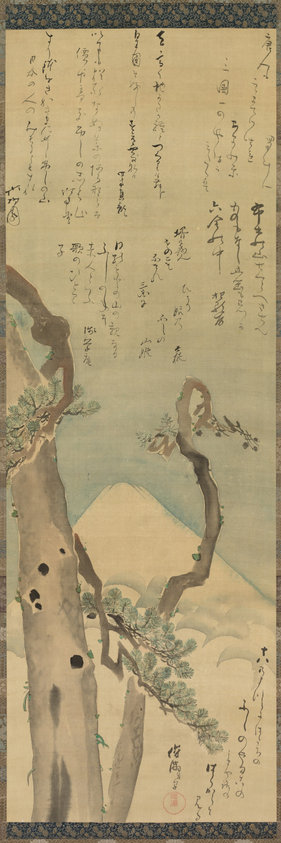
Mt. Fuji through Pines
Kubo Shunman dashed off this loose image of Mt. Fuji viewed in the distance from behind pine trees as a performance painting, or sekiga. He did it on the spot in the company of members of his poetry club. Six of them, including the club's founder Yadoya no Meshimori (Rokujuen, 1753–1830), added kyoka poems, 31-syllable poems like the classical Japanese waka poem in form, but with a heavy emphasis on humor. Shunman jotted down a poem as well, in the bottom right corner of the painting, before signing and sealing it. Each poem takes the painted image as its point of departure.
Colors in this work
Details
- Dimensions
- painting only: height 0.9 m, width 0.308 m; including mounting: height 1.835 m, width 0.495 m
- Department
- Japanese Art
- Holding institution
- Cleveland Museum of Art
- Palette
-
Select a color to find related artworks.
- Image provider
- cleveland-museum-of-art
- License
- CC0-1.0
- Credit
- Kelvin Smith Fund
Art Genome Taxonomy
11 tags
Subject Matter
-
Landscapes Both · 99%
The image shows a distant mountain landscape framed by trees, and the catalog identifies the subject as Mt. Fuji viewed from behind pine trees.
-
Flora Both · 99%
Pine trunks, branches, and clusters of needles are prominent in the foreground, consistent with the catalog description of Fuji seen through pines.
-
Text Both · 99%
Numerous brush-written poems occupy the upper and lower areas of the image; the catalog identifies six kyoka poems by poetry-club members and an additional poem by Shunman.
Visual Qualities
-
Calligraphic Visual · 96%
The inscriptions use visibly expressive, flowing brushwork and function as a major formal element of the composition.
Medium and Techniques
-
Hanging Scroll Metadata · 99%
The catalog identifies the object as a hanging scroll made with ink and color on silk.
-
Painting Metadata · 99%
The museum classifies the object as a painting and specifies ink and color on silk.
-
East Asian Calligraphy Visual · 95%
The scroll contains sustained Japanese brush writing, visibly rendered as East Asian calligraphy across the pictorial field.
Time Periods
-
18th Century Art Metadata · 96%
The catalog date begins in the late eighteenth century, around 1780.
-
19th Century Art Metadata · 91%
The catalog date extends into the early nineteenth century.
Geographic Regions
-
Japanese Art Metadata · 99%
The museum classifies the work as Japanese Art and records its place of origin as Japan.
Cultural and Religious Styles
-
Edo Art Metadata · 97%
The catalog places the work in Japan’s Edo period, dated late 1700s to early 1800s.
Source & rights
Kubo Shunman (Japanese, 1757–1820). Mt. Fuji through Pines. Cleveland Museum of Art.
High-resolution sources
- Original TIFF ↗ 2,620 × 7,854 · Cleveland Museum Of Art · Available