Royal Horse Inspection
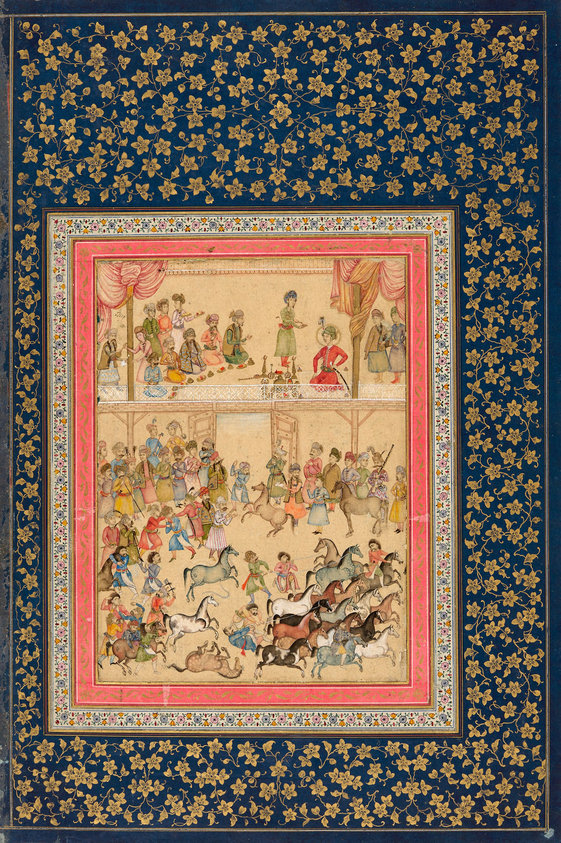
The setting for the painting is the royal stables in Isfahan. The upper portion of the scene consists of a platform on which are gathered the shah, or Persian king, who appears next to the column on the right; five kneeling courtiers; and various attendants serving fruit and wine. The king is identified in the artist’s signature at the upper left as Shah ‘Abbas II, who died in 1666, but it is possible that the undated painting was executed after his death. The ruler’s status is emphasized by his golden halo and by the opulent gold and jeweled vessels placed before him. The lower portion shows a roundup of horses who bear the trident-like royal brand on their flanks; they move in a spiral that coils counterclockwise from the upper right. The scene bursts with energy and looks chaotic—a brawl is taking place at the lower left—but the courtiers and handlers seem to be getting control of the animals. The figures on the platform, meanwhile, pay no attention to the commotion below. The painting represents a new journalistic, even anecdotal approach to Persian painting introduced in the second half of the seventeenth century. The viewer gets the sense that the work may record a specific moment in daily life at court and that it was observed firsthand. Figures no longer conform to stock types but are highly individualized by facial features and dress. Standing just to the right of center in the upper part of the roundup scene is a man wearing a gold, fur-lined, armless jacket. He holds a list and is writing notes while conferring with a young man in a blue robe. The man taking notes may well be the supervisor of the royal stud, one of whose responsibilities was to inspect the king’s stables and keep an inventory of the animals.
Colors in this work
Details
- Artist
- 'Aliquli Jabbadar
- Dimensions
- Page: 46.8 × 31.1 cm, Painting: 23.1 × 17 cm (Page: 18 1/2 × 12 1/4 in., Painting: 9 1/8 × 6 11/16 in.)
- Origin
- Iran
- Holding institution
- Art Institute of Chicago
- Palette
-
Select a color to find related artworks.
- Image provider
- wikimedia-commons
- License
- Public domain
- Credit
- Lucy Maud Buckingham Collection
Art Genome Taxonomy
12 tags
Subject Matter
-
Equestrian Both · 99%
The catalog identifies the subject as a royal horse inspection, and the image prominently depicts numerous horses, riders, and handlers.
-
Royalty and Aristocracy Both · 98%
The upper register shows a shah with courtiers and attendants in a royal-stables setting, consistent with the catalog description of courtly activity.
-
Narrative Both · 96%
The work depicts a specific event involving a royal gathering, horse inspection, handlers, and a commotion in the lower register.
-
Movement Visual · 99%
The lower register contains running, rearing, turning, and overlapping horses and human figures, creating a pronounced sense of physical activity.
Visual Qualities
-
Patterns Visual · 99%
Repeated floral vines, blossoms, and patterned borders surround the central painted scene, especially across the deep-blue outer field.
-
Dense Composition Visual · 99%
The page is densely occupied by figures, horses, architecture, vessels, costumes, and ornamental borders, leaving little unoccupied space within the designed field.
Medium and Techniques
-
Painting Metadata · 99%
The classification is Painting, and the medium is specified as opaque watercolor and gold on paper.
-
Watercolor Metadata · 99%
The catalog explicitly identifies opaque watercolor as part of the medium.
-
Work on Paper Metadata · 99%
The catalog specifies that the painting is executed on paper.
Time Periods
-
17th Century Art Metadata · 99%
The catalog dates the work to the late seventeenth century, within the stated 1650–1675 range.
Geographic Regions
-
Iranian Art Metadata · 99%
The work is cataloged as originating in Iran, probably Isfahan, and is associated with Persian and Iranian styles.
Materials
-
Gold Both · 98%
Gold is explicitly listed in the medium, and gold-colored ornament and highlights are prominent throughout the image.
Source & rights
Aliquli Jabbadar. https://www.artic.edu/artworks/76869
High-resolution sources
- Original image ↗ 1,995 × 3,000 · Wikimedia Commons · Availability not yet probed