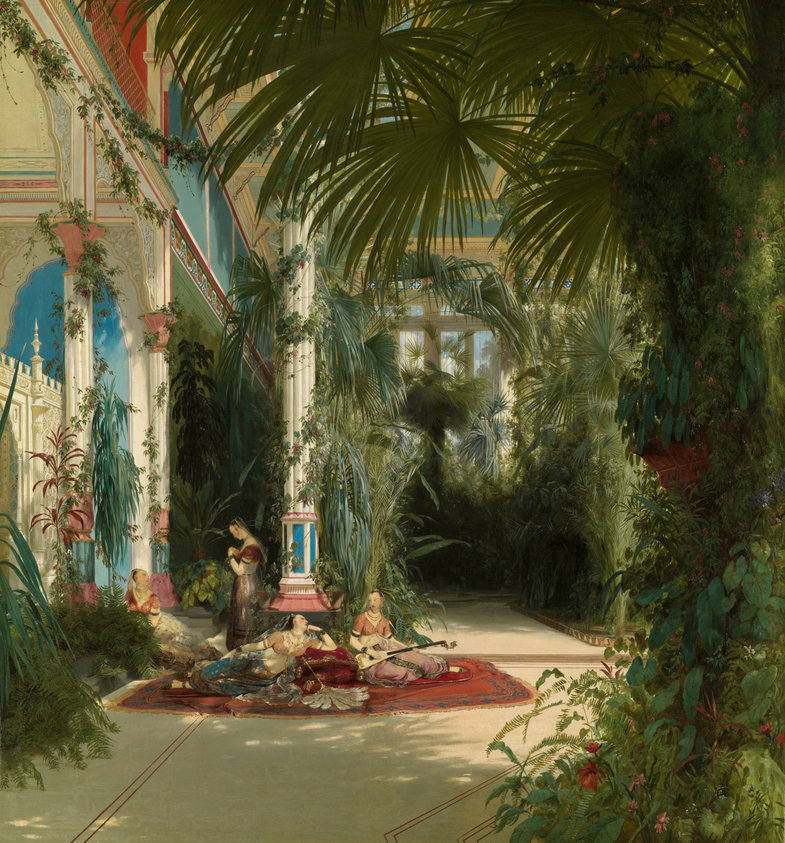
The Interior of the Palm House on the Pfaueninsel Near Potsdam
The work of Carl Blechen, a pivotal figure in 19th-century German painting, marks a transition from Romanticism to a more realistic view of nature. Inspired in part by his encounter with the Italian landscape and light during a trip he made around 1828 or 1829, Blechen developed a fluid technique that enabled him to capture fleeting atmospheric effects. He often used his landscapes as settings for mysterious figures, reflecting his early contact with Romantic painting and theater.
Colors in this work
Details
- Artist
- Carl Blechen
- Date
- 1834
- Medium
- Oil on canvas
- Dimensions
- 135 × 126 cm (52 1/2 × 50 in.); Framed: 155 × 145.5 cm (61 × 57 1/4 in.)
- Origin
- Germany
- Department
- Painting and Sculpture of Europe
- Holding institution
- Art Institute of Chicago
- Palette
-
Select a color to find related artworks.
- Image provider
- art-institute-chicago
- License
- CC0-1.0
- Credit
- Through prior acquisitions of the George F. Harding Collection; L.L. and A.S. Coburn and Alexander A. McKay endowments; through prior gift of William Wood Prince; through prior acquisitions of the Charles H. and Mary F. S. Worcester Endowment
Art Genome Taxonomy
12 tags
Subject Matter
-
Interiors Both · 99%
The title and museum description identify the Palm House as the setting; the image is dominated by an enclosed, decorated architectural interior with columns, arches, and glazed openings.
-
Architecture's Effects Both · 94%
The museum explicitly describes the work as playing with the boundaries between architecture and nature, while the image gives the building a major compositional role amid the vegetation.
-
Human Figure Both · 98%
The image visibly contains several human figures, presented as female, and the museum lists women among the subjects.
-
Flora Both · 99%
Palms, vines, flowering plants, and dense foliage fill much of the composition; the museum lists plants, palms, flowers, and trees among the subjects.
-
Leisure Both · 96%
The figures are shown seated, reclining, conversing, and making music within the Palm House; leisure is explicitly listed as a museum subject.
Styles and Movements
-
Orientalism Metadata · 90%
The museum describes the figures and setting as derived from colonialist fantasies of non-European women and records the style as orientalizing; orientalism is the corresponding catalog category.
Visual Qualities
-
Dense Composition Visual · 98%
Overlapping foliage, architectural ornament, textiles, figures, and receding openings create a densely populated visual field with few empty areas.
-
Highly Ornamented Visual · 96%
The left architecture, columns, wall panels, plant containers, garments, and rug display extensive decorative patterning and ornament.
Medium and Techniques
-
Oil Painting Both · 99%
The museum records the medium as oil on canvas, and the image visibly depicts a painted canvas composition.
Time Periods
-
19th Century Art Metadata · 99%
The work is dated 1834, placing it within the nineteenth century.
Geographic Regions
-
German Art Metadata · 99%
The artist is identified as German and the place of origin is recorded as Germany.
Textiles
-
Rug Both · 98%
A large patterned rug is clearly visible beneath the foreground figures, and rugs are listed among the museum’s subjects.
Source & rights
Carl Blechen. The Interior of the Palm House on the Pfaueninsel Near Potsdam. The Art Institute of Chicago.
High-resolution sources
- IIIF image service ↗ 1,686 × 1,810 · Art Institute Chicago · Availability not yet probed