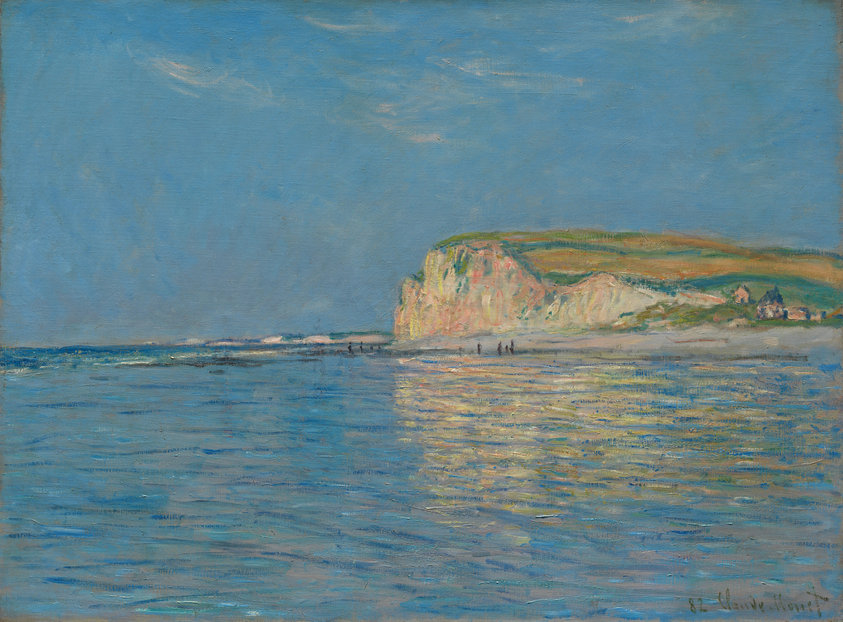
Low Tide at Pourville, near Dieppe, 1882
This is one of several views Claude Monet painted of Pourville, a fishing village on the north coast of France in Normandy. Pourville featured a boardwalk, a broad beach, and stunning cliffs. According to the artist's correspondence, the village was nothing special, but he was inspired by the landscape: "One could not be any closer to the sea than I am, on the pebbled beach itself and the waves beat at the foot of the house." During the spring of 1882 in Pourville, Monet stayed in a small hotel similar to the dwellings seen at the foot of the cliff to the right in this painting.
Colors in this work
Details
- Date
- 1882
- Medium
- oil on fabric
- Dimensions
- framed: height 0.654 m, width 1.067 m, depth 0.105 m; unframed: height 0.599 m, width 0.813 m
- Origin
- France, 19th century
- Department
- Modern European Painting and Sculpture
- Holding institution
- Cleveland Museum of Art
- Palette
-
Select a color to find related artworks.
- Image provider
- cleveland-museum-of-art
- License
- CC0-1.0
- Credit
- Gift of Mrs. Henry White Cannon
Art Genome Taxonomy
8 tags
Subject Matter
-
Landscapes and Waterscapes Both · 99%
The image visibly depicts a broad coastal landscape with sea, beach, and cliffs, while the Cleveland Museum of Art identifies the subject as Pourville, a fishing village on the Normandy coast.
-
Waterscapes Visual · 99%
Water and reflective shallows occupy much of the foreground, with the shoreline and cliff extending across the middle distance.
-
Light as Subject Interpretive · 82%
Atmospheric light and reflected color are prominent visual concerns, especially in the luminous water and the shifting pink, cream, ochre, and green passages of the cliff and shore.
Styles and Movements
-
Impressionism Visual · 91%
The painting is rendered with broken, visible strokes, softened contours, and juxtaposed color accents characteristic of an Impressionist visual reading.
Medium and Techniques
-
Oil Painting Metadata · 99%
The museum catalog identifies the work as a painting in oil on fabric.
-
Large Brushstrokes/Loose Brushwork Visual · 90%
Loose, predominantly horizontal brushwork is clearly visible across the sky, water, beach, and cliff, without sharply delineated contours.
Time Periods
-
19th Century Art Metadata · 99%
The catalog dates the work to 1882, placing it within the nineteenth century.
Geographic Regions
-
French Art Metadata · 99%
The catalog identifies Claude Monet as French and records the place of origin as France.
Source & rights
Claude Monet (French, 1840–1926). Low Tide at Pourville, near Dieppe, 1882. Cleveland Museum of Art.
High-resolution sources
- Original TIFF ↗ 15,254 × 11,254 · Cleveland Museum Of Art · Available