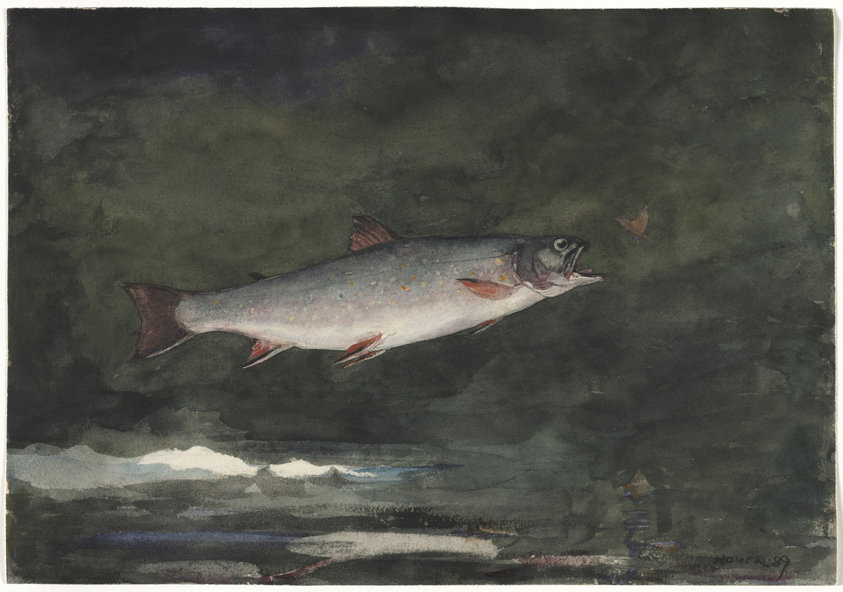
Leaping Trout
In 1886, Winslow Homer began to produce oil paintings and watercolors of subjects in the Adirondack Mountains, where he and his brother Charles had fished and hunted since the 1870s. In Leaping Trout, a silvery trout propels itself from the water in pursuit of a hapless insect or a fisherman’s fly. Homer’s choice to adopt the fish’s perspective, rather than a fisherman’s, is quite unconventional and heightens the drama and immediacy of the scene. His technique, influenced by the free brushwork of French Impressionism, similarly animates his still-life subject. Luminous washes of transparent blue and grey watercolor suggest the fish’s iridescent skin, while opaque pricks of bright red on its body lend a decorative effect reminiscent of Japanese prints. On the water’s surface, Homer uses scraping to create two brilliant white highlights, and dry brushing to produce the impression of a reflective surface. Although the overall effect is mysterious and dreamlike, the color and movement of the fish is carefully studied, suggesting Homer’s desire to appeal to the sportsmen who might buy his works.
Colors in this work
Details
- Date
- 1889
- Medium
- watercolor over graphite
- Dimensions
- sheet: height 0.35 m, width 0.506 m
- Origin
- America
- Department
- Drawings
- Holding institution
- Cleveland Museum of Art
- Palette
-
Select a color to find related artworks.
- Image provider
- cleveland-museum-of-art
- License
- CC0-1.0
- Credit
- Anonymous Gift
Art Genome Taxonomy
11 tags
Subject Matter
-
Animals Both · 99%
The composition is centered on a single trout, and the museum describes it as a leaping fish pursuing an insect or a fisherman’s fly.
-
Movement Visual · 98%
The trout is shown extended in midair with its fins spread, and the broken water surface beneath it reinforces the depicted action.
-
Water Visual · 99%
Dark water and horizontal ripples occupy the lower portion of the image and surround the leaping fish.
Visual Qualities
-
Dark Colors Visual · 98%
Deep green, gray, blue, and black passages dominate the image, with pale highlights and localized red-orange accents.
-
Iridescence/Opalescence Both · 91%
The fish has a luminous, changing silvery surface, and the museum describes the transparent washes as suggesting iridescent skin.
Medium and Techniques
-
Drawing Metadata · 99%
The Cleveland Museum of Art classifies the object as a drawing and records its medium as watercolor over graphite.
-
Watercolor Metadata · 99%
The recorded medium is watercolor over graphite, and the object is a sheet measuring approximately 0.35 by 0.506 meters.
-
Work on Paper Metadata · 98%
The work is a drawing on a sheet of paper measuring approximately 0.35 by 0.506 meters.
-
Stains/Washes Both · 94%
The image contains broad translucent washes, and the museum specifically describes luminous transparent blue-gray watercolor washes in the work.
Time Periods
-
19th Century Art Metadata · 99%
The work is dated 1889, placing it within nineteenth-century art.
Geographic Regions
-
American Art Metadata · 99%
The artist is identified as American and the place of origin is recorded as America.
Source & rights
Winslow Homer (American, 1836–1910). Leaping Trout. Cleveland Museum of Art.
High-resolution sources
- Original TIFF ↗ 5,984 × 4,203 · Cleveland Museum Of Art · Available