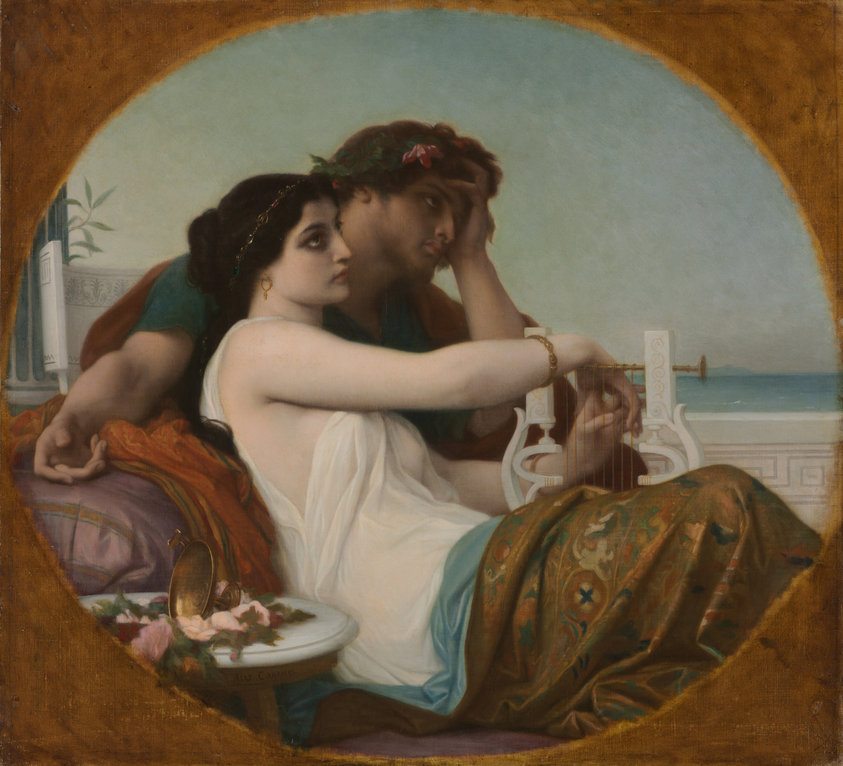
Aglaida and Boniface
The French painter Alexandre Cabanel was a favorite of Emperor Napoleon III and a leader of the academic style that emphasized precise drawing and smoothly modeled forms. This painting depicts the wealthy Roman woman Aglaida and her concubine slave Boniface, here living as pagan sinners in Rome around 290 CE. On a trip to Tarsus on the Anatolian coast, Boniface converted to Christianity and was tortured and beheaded. Aglaida also converted to Christianity, gave all her possessions to the poor, and built a church for Boniface's relics.
Colors in this work
Details
- Date
- c. 1857
- Medium
- oil on canvas
- Dimensions
- unframed: height 0.622 m, width 0.68 m
- Origin
- France, 19th century
- Department
- Modern European Painting and Sculpture
- Holding institution
- Cleveland Museum of Art
- Palette
-
Select a color to find related artworks.
- Image provider
- cleveland-museum-of-art
- License
- CC0-1.0
- Credit
- Bequest of Elizabeth Ludwig Fennell
Art Genome Taxonomy
11 tags
Artistic Disciplines
-
Music Visual · 91%
A large stringed instrument, apparently a lyre or small harp, is a major foreground element and is being played or handled by the woman.
Subject Matter
-
Human Figure Visual · 100%
Two prominently rendered human figures occupy the center of the composition.
-
Narrative Both · 98%
The museum identifies the figures as Aglaida and Boniface within a specific historical-religious narrative, while their gestures, costumes, setting, and interaction visibly stage a narrative scene.
-
Mythology and Religion Metadata · 95%
The museum connects the subject to paganism, Boniface’s conversion to Christianity and martyrdom, and Aglaida’s subsequent conversion and charitable works.
-
Classical Figure Both · 94%
The museum places the episode in Rome around 290 CE, and the image uses draped garments, a lyre-like instrument, wreaths, and classical architectural decoration to evoke an ancient setting.
Styles and Movements
-
19th Century French Academy Both · 99%
The Cleveland Museum of Art dates the work to circa 1857 and describes Cabanel as a leader of the academic style; the image shows precise contours, idealized anatomy, smooth modeling, and a polished finish.
Visual Qualities
-
Highly Ornamented Visual · 95%
The composition contains richly patterned textiles, jewelry, floral adornments, drapery, a decorated instrument, and ornamental architectural borders.
-
Patterns Visual · 93%
Repeated textile motifs and geometric architectural borders create clearly visible patterned surfaces throughout the scene.
Medium and Techniques
-
Oil Painting Metadata · 100%
The recorded medium is oil on canvas.
Time Periods
-
19th Century Art Metadata · 99%
The museum dates the painting to circa 1857, placing it in the nineteenth century.
Geographic Regions
-
French Art Metadata · 99%
The artist and place of origin are identified as French and France, nineteenth century.
Source & rights
Alexandre Cabanel (French, 1823–1889). Aglaida and Boniface. Cleveland Museum of Art.
High-resolution sources
- Original TIFF ↗ 5,082 × 4,618 · Cleveland Museum Of Art · Available