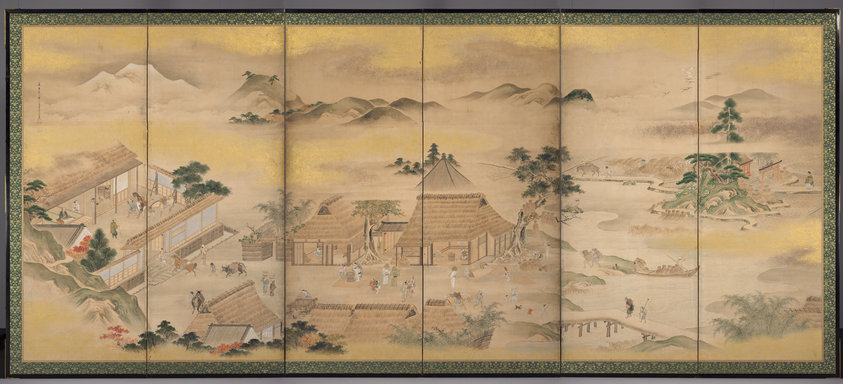
Spring and Autumn Farming (Autumn)
These screens present the cycle of the farming year, starting with spring at right and ending with fall at left. Close examination of these screens reveals moments of games and amusement, the enjoyment of meals as well as intellectual and spiritual pursuits interspersed among the scenes of cultivating and preparing the rice harvest.The artist Kō Sūkoku is considered the 18th-century heir in style and attitude to Hanabusa Itchō (1652–1724). Itchō’s work incorporated elements from Kano school, ukiyo-e, and literati styles of painting. Kō trained with one of Hanabusa’s pupils, Sawaki Sūshi, who was best known for scenes depicting everyday life and customs.
Colors in this work
Details
- Date
- 1700s
- Dimensions
- overall: height 1.702 m, width 3.535 m
- Department
- Japanese Art
- Holding institution
- Cleveland Museum of Art
- Palette
-
Select a color to find related artworks.
- Image provider
- cleveland-museum-of-art
- License
- CC0-1.0
- Credit
- Gift of Dr. Norman Zaworski
Art Genome Taxonomy
12 tags
Subject Matter
-
Landscapes Both · 99%
The screen depicts an expansive rural landscape with layered mountains, fields, waterways, trees, paths, and buildings; the museum describes it as part of a seasonal farming cycle.
-
Atmospheric Landscapes Visual · 97%
Distant mountain ridges, pale atmospheric passages, and open areas of water and haze create pronounced spatial recession across the screen.
-
Rural Life Both · 99%
Thatched farm buildings, cultivated fields, and village activity dominate the scene, while the catalog explicitly describes the farming year and preparation of the rice harvest.
-
Scenes of Everyday Life Both · 94%
The image presents figures and activities distributed around homes, fields, paths, and waterways; the catalog describes games, meals, and other everyday pursuits alongside agricultural labor.
-
Work and Workers Both · 95%
Figures appear throughout the agricultural setting, and the catalog specifically identifies cultivation and preparation of the rice harvest as central activities.
Visual Qualities
-
Earth Tones Visual · 94%
The painted landscape and architecture are rendered predominantly in muted ochres, browns, gray-greens, and other subdued natural hues.
Medium and Techniques
-
Screen Format Metadata · 99%
The museum identifies the object as a six-panel folding screen.
-
Painting Metadata · 99%
The catalog classifies the object as a painting.
-
Work on Paper Metadata · 99%
The listed medium is ink, light color, gold, and silver on paper.
Time Periods
-
18th Century Art Metadata · 99%
The museum dates the work to the 1700s, with a date range of 1750–1799.
Geographic Regions
-
Japanese Art Metadata · 99%
The place of origin is recorded as Japan, and the work is classified by the museum within Japanese Art.
Materials
-
Gold Both · 99%
A luminous gold-toned ground is clearly visible, and gold is explicitly listed in the catalog medium.
Source & rights
Kō Sūkoku (Japanese, 1730–1804). Spring and Autumn Farming (Autumn). Cleveland Museum of Art.
High-resolution sources
- Original TIFF ↗ 17,016 × 7,752 · Cleveland Museum Of Art · Available