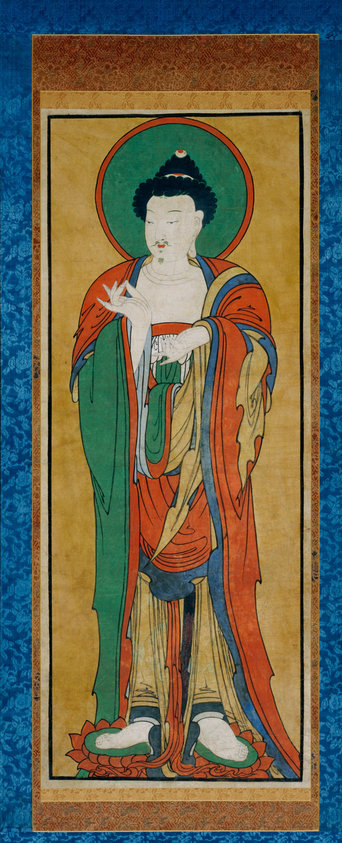
Tathagata Buddha
Buddhist paintings of the late Joseon period (from the 17th to the 19th century) have several characteristics different from their precedents. Generally, they were painted in bright mineral pigments on either thick paper or hemp. This large painting, which measures more than 2 meters tall, used to serve as a banner for outdoor Buddhist ceremonies such as the water-and-land rite (水陸會).
Colors in this work
Details
- Artist
- Unknown artist
- Date
- late 1800s
- Dimensions
- overall: height 2.14 m, width 0.694 m; painting only: height 0.532 m, width 0.489 m; with mount: height 1.56 m, width 0.564 m
- Department
- Korean Art
- Holding institution
- Cleveland Museum of Art
- Palette
-
Select a color to find related artworks.
- Image provider
- cleveland-museum-of-art
- License
- CC0-1.0
- Credit
- Worcester R. Warner Collection
Art Genome Taxonomy
10 tags
Subject Matter
-
Deities and Holy Figures Both · 99%
The title identifies Tathagata Buddha, and the image shows a haloed sacred figure in a Buddhist devotional format.
Visual Qualities
-
Symmetrical Visual · 96%
The painted field is organized around a central upright figure, circular halo, lotus pedestal, and balanced rectangular borders, producing a strongly axial and near-symmetrical composition.
-
Bright and Vivid Colors Visual · 97%
Saturated red, green, blue, and ocher passages create a vivid polychrome appearance across the robes, halo, lotus pedestal, and surrounding ground.
Medium and Techniques
-
Painting Metadata · 99%
The Cleveland Museum of Art classifies the work as a painting and records the medium as ink and color on paper.
-
Hanging Scroll Metadata · 99%
The catalog identifies the object as a hanging scroll and describes its former use as a banner for outdoor Buddhist ceremonies, including the water-and-land rite.
-
Frontal Perspective Visual · 93%
The figure faces forward in a formal, vertically oriented presentation with minimal spatial recession.
Time Periods
-
19th Century Art Metadata · 99%
The catalog dates the work to the late 1800s, within the 19th century.
Geographic Regions
-
Korean Art Metadata · 99%
The work is identified as Korean art from Korea during the Joseon dynasty.
Materials
-
Use of Paper Metadata · 99%
The recorded medium is ink and color on paper.
Cultural and Religious Styles
-
Buddhist Art and Architecture Metadata · 99%
The work is described by the museum as a late Joseon Buddhist painting, with a former ritual use in outdoor Buddhist ceremonies.
Source & rights
Unknown artist. Tathagata Buddha. Cleveland Museum of Art.
High-resolution sources
- Original TIFF ↗ 3,724 × 9,190 · Cleveland Museum Of Art · Available