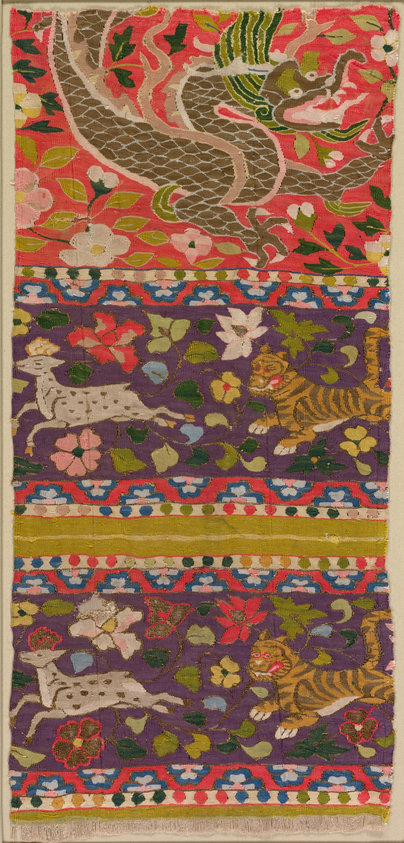
Tigers Chasing Deer, with Dragon
This reversible tapestry (kesi) fragment woven with silk and metal thread is a section from yardage likely intended for a garment, but no contemporary paintings exist to confirm this. The starting, bottom edge of the textile is preserved which indicates the bands at the base would have been the cuff ends of a garment. The design motifs of this kesi—a dragon at the top, bands of pearls and split palmettes, and tigers chasing deer with mushroom-shaped antlers—are a synthesis of Western and Chinese elements. The pearls, palmettes, and deer motifs originated in Iran and Sogdiana (an area east of the Caspian Sea and northwest of the Himalayas) but migrated east to China during the Tang dynasty (618–907). Although these motifs disappeared from Chinese art after the fall of the Tang, they survived in Central Asia. In contrast, the dragon is Chinese in origin, but here has a Central Asian form (particularly its extended snout).
Colors in this work
Details
- Artist
- Unknown artist
- Date
- 1000s–1200
- Dimensions
- overall: height 0.58 m, width 0.272 m; mounted: height 0.756 m, width 0.438 m
- Department
- Textiles
- Holding institution
- Cleveland Museum of Art
- Palette
-
Select a color to find related artworks.
- Image provider
- cleveland-museum-of-art
- License
- CC0-1.0
- Credit
- Leonard C. Hanna Jr. Fund
Art Genome Taxonomy
12 tags
Subject Matter
-
Animals Both · 99%
The title and museum description identify a dragon, tigers, and deer, all of which are plainly visible in the composition.
-
Flora Visual · 98%
Flowers, leaves, scrolling vines, and palmette-like vegetal forms fill the registers and borders around the animals.
-
Cross-Cultural Dialogue Metadata · 92%
The museum describes the design as a synthesis of Western and Chinese elements, including motifs associated with Iran, Sogdiana, Central Asia, and China.
Visual Qualities
-
Patterns Visual · 99%
Repeated animal scenes, floral motifs, pearl-like units, scrolling bands, and horizontal borders create a strongly patterned ornamental surface.
-
Dense Composition Visual · 97%
The fragment has a dense composition in which animals, foliage, flowers, and border ornament occupy most of the visible ground.
-
Bright and Vivid Colors Visual · 97%
Saturated red and purple grounds are contrasted with vivid green, blue, ocher, white, pink, and brown details.
Medium and Techniques
-
Repetition Visual · 96%
The two tiger-and-deer registers repeat a similar arrangement, while border units recur across the width of the textile.
Time Periods
-
1000 - 1400 CE Art Metadata · 98%
The recorded date range is 1000–1199, which falls within the 1000–1400 CE Art category.
Geographic Regions
-
Chinese Art Metadata · 99%
The recorded place of origin is China, Eastern, in the 11th–12th century.
Materials
-
Natural Fibers Metadata · 99%
The museum specifies silk as part of the medium; silk is a natural fiber.
-
Gold Metadata · 99%
Gold thread is explicitly listed in the museum’s medium description.
Textiles
-
Textile Arts Both · 99%
The Cleveland Museum of Art catalogs the work as a reversible tapestry (kesi), and the image clearly shows a densely woven, thread-based textile surface.
Source & rights
Unknown artist. Tigers Chasing Deer, with Dragon. Cleveland Museum of Art.
High-resolution sources
- Original TIFF ↗ 3,765 × 7,866 · Cleveland Museum Of Art · Available