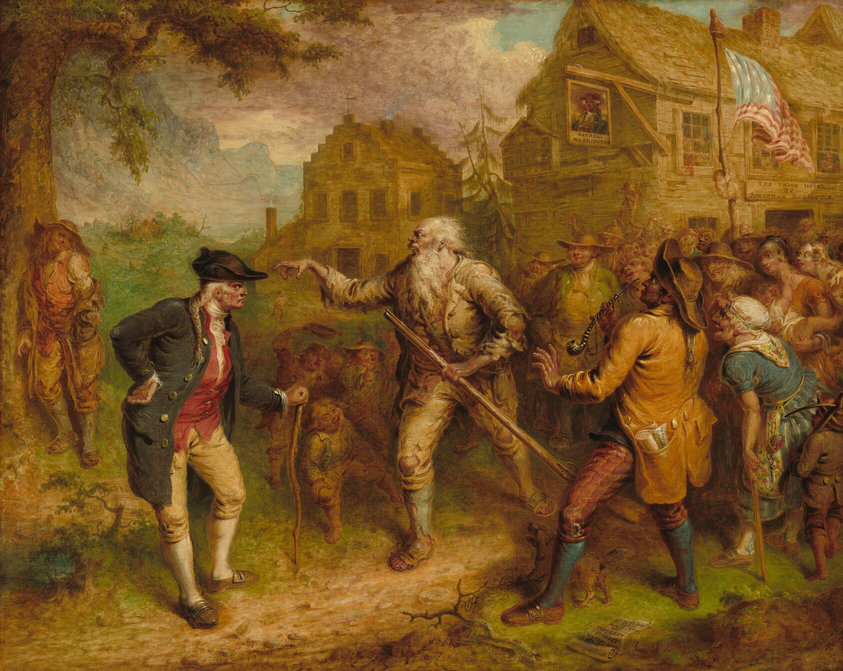
The Return of Rip Van Winkle
In front of a crowd of at least two dozen people, an old man with a long white beard and hair, wearing tattered clothing, points with a crooked finger toward another man in this horizontal painting. All the people have pale, peachy skin except one man with light brown skin at the front of the crowd, to our right. The men in the painting wear waistcoats or jackets, with pants that buckle at the knee over stockings. At the center of the painting, the white hair of the oldest man, Rip van Van Winkle, flies back from his balding head as he looks to our left with bulging eyes. He has a bulb-like nose and his mouth is open. He holds the long barrel of a rifle with one hand and points to our left with gnarled fingers with the other. His shirt, jacket, and pants are all parchment white, with gaping holes in the elbows and knees. One calf is covered in a tattered, sky-blue stocking and the other leg is bare. All ten toes poke out of worn, buckled shoes. Rip Van Winkle points and looks wildly at the man standing nearby, to our left. That man’s cheeks and hooked nose are flushed red. Facing our right in profile, he glowers at Rip Van Winkle under lowered brows, and his pink lips turn downward at the corner we can see. A white braid falls over the shoulder closer to us, and he plants the back of that hand on his hip. His other hand rests on a wooden cane. He wears a tricorn hat and a navy-blue jacket with large, silver buttons over a rose-red vest and white shirt. A gold object, perhaps a pocket watch fob, hangs at his hip over straw-yellow pants. A third man, to our right, looks on with one hand raised, palm facing out. He holds a long, silver pipe in his other hand. He has brown skin, a pointed nose, full, pink lips, and bulging eyes. A rolled-up paper is tucked into a pocket of his honey-brown jacket, and he wears brick-red pants with teal-blue stockings. The bottom edge of the paper reads, “seventy-six.” Another partially unfurled scroll at his feet reads, “ELECTION RIGHTS OF CITIZENS LIBERTY BUNKER’S HILL.” A man leans against a tree beyond this trio, to our left. To our right, a dense crowd of dozens of men, women, and children, painted more loosely and with more exaggerated facial features, are clustered before a tan-colored house with a stepped roof and a two-story inn. The latter has a sign hanging from the eave with a portrait of a man with white hair, wearing a military uniform. The sign is labeled beneath with “GENERAL WASHINGTON.” People look on from the upstairs windows. An American flag with thirteen stars flutters from a flagpole, which a boy climbs. A sign over the door reads, “THE UNION HOTEL BY JONATHAN DOODITTLE.” Another sign, partially cropped by the right edge of the painting, reads, “ELECTIO RIGHT OF CITIZ.” Lilac-purple clouds billow up over aquamarine-blue hills in the distance, against a blue sky. The artist signed and dated the painting as if he had inscribed a rock near the lower center, “J. Quidor, N.Y. 189,” the next to last number obscured.
Colors in this work
Details
- Artist
- John Quidor
- Date
- 1849
- Medium
- oil on canvas
- Dimensions
- overall: 101 x 126.5 cm (39 3/4 x 49 13/16 in.) framed: 139.1 x 159.4 x 9.5 cm (54 3/4 x 62 3/4 x 3 3/4 in.)
- Department
- CAB
- Holding institution
- National Gallery of Art
- Palette
-
Select a color to find related artworks.
- Image provider
- national-gallery-of-art
- License
- CC0-1.0
- Credit
- Andrew W. Mellon Collection
Art Genome Taxonomy
10 tags
Subject Matter
-
Narrative Both · 97%
The title identifies a return, and the image presents an acted encounter among central figures and a surrounding audience, with pointing and raised-hand gestures.
-
Crowds Both · 99%
A substantial group of men, women, and children gathers across the middle and right portions of the composition, with additional figures in the foreground and background.
-
Political Both · 98%
The painting includes an American flag, a portrait of General Washington, and legible references to elections, citizens’ rights, liberty, the Union, and Bunker’s Hill.
-
Text Both · 99%
Multiple signs and scrolls are integrated into the scene, including “GENERAL WASHINGTON,” “THE UNION HOTEL BY JONATHAN DOODITTLE,” and text concerning elections and citizens’ rights.
-
Human Figure Visual · 99%
The composition prominently features numerous individualized human figures, especially the central bearded man, the tricorn-hatted man at left, and the pipe-holding figure in the right foreground.
Visual Qualities
-
Dense Composition Visual · 98%
Overlapping figures, village architecture, signage, landscape, and props fill the broad horizontal picture surface, producing a tightly packed composition.
-
Earth Tones Visual · 97%
Brown, ocher, olive, and muted reddish tones predominate, with darker clothing and shadowed forms offset by blue, white, and red accents.
Medium and Techniques
-
Painting Metadata · 99%
The National Gallery of Art classifies the work as a painting.
-
Oil Painting Metadata · 99%
The catalog identifies the medium as oil on canvas.
Time Periods
-
19th Century Art Metadata · 99%
The work is dated 1849, placing it within the nineteenth century.
Source & rights
John Quidor. The Return of Rip Van Winkle. Courtesy National Gallery of Art, Washington.
High-resolution sources
- IIIF image service ↗ 17,277 × 13,744 · National Gallery Of Art · Available