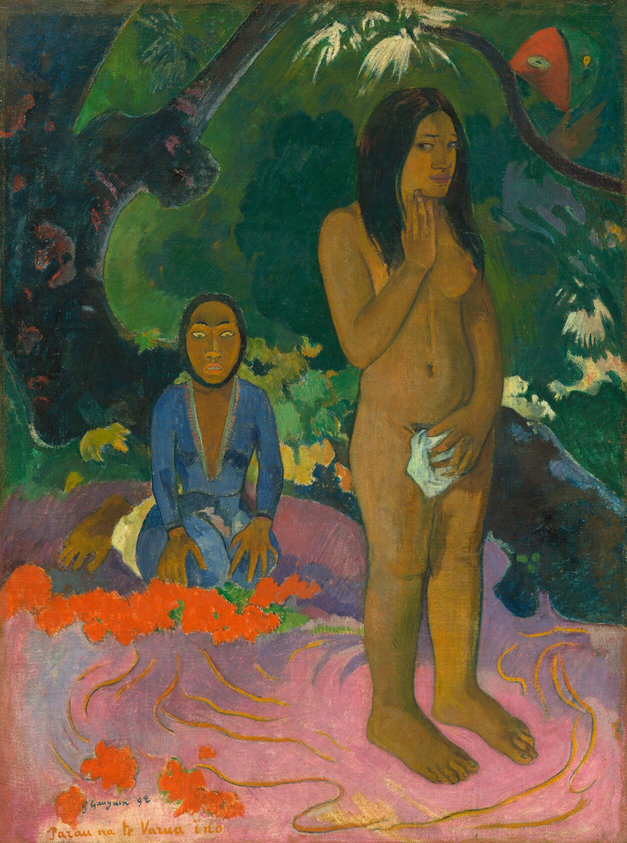
Parau na te Varua ino (Words of the Devil)
A nude woman with brown skin and long black hair stands to our right against a landscape swirling with jewel-toned greens, pinks, and purples while a man, also with brown skin, sits under a tree behind her in this stylized vertical painting. The woman's body is angled to our right, and she cuts her black eyes back to look off to our left. She touches her chin with the fingertips of her right hand, closer to us, while her left hand holds a white cloth over her groin. The ground beneath her is swirled with bright pink, lilac purple, and some strokes of canary yellow. To our left and behind the woman, the man wears a topaz-blue robe, and he kneels with his hands on his knees. A band of vivid orange and kelly green in front of his knees could be abstracted flowers. His oval face is rimmed with a band of black. He has a wide nose, and his pink lips are parted to reveal his teeth. His eyes are wide open as he looks down under black brows. A craggy, dark teal-blue tree trunk curves up and across the background, and a red and green faced serpent floats near the upper right corner. The artist signed, dated, and inscribed the title in the lower left corner, "P Gauguin 92 Parau na te Varua ino."
Colors in this work
Details
- Artist
- Paul Gauguin
- Date
- 1892
- Medium
- oil on canvas
- Dimensions
- overall: 91.76 × 68.5 cm (36 1/8 × 26 15/16 in.) framed: 112.4 × 88.27 × 8.89 cm (44 1/4 × 34 3/4 × 3 1/2 in.)
- Department
- CF
- Holding institution
- National Gallery of Art
- Palette
-
Select a color to find related artworks.
- Image provider
- national-gallery-of-art
- License
- CC0-1.0
- Credit
- Gift of the W. Averell Harriman Foundation in memory of Marie N. Harriman
Art Genome Taxonomy
12 tags
Subject Matter
-
Nude Both · 100%
The catalog identifies a nude woman, and the image clearly shows her full unclothed figure standing in the foreground.
-
Human Figure Both · 99%
A standing woman and a seated figure are the two principal human figures in the composition.
-
Figures in Nature Both · 98%
The figures appear outdoors within dense vegetation, beneath and beside a large tree.
-
Flora Both · 97%
Leafy vegetation and numerous clusters of flowers are prominent throughout the setting.
-
Animals Both · 96%
A serpent-like creature is visible in the upper-right area, and the catalog describes it as a serpent.
-
Implied Narrative Interpretive · 78%
The title, the serpent, and the figures’ watchful poses suggest an unresolved narrative rather than a clearly depicted event.
Styles and Movements
-
Post-Impressionism Interpretive · 80%
The work’s saturated non-naturalistic color, simplified forms, and compressed space support a broad post-impressionist classification, although no style is supplied in the catalog metadata.
Visual Qualities
-
Bright and Vivid Colors Visual · 98%
The painting uses strongly saturated greens, pinks, purples, oranges, yellows, and blues.
-
Curvilinear Forms Visual · 92%
The arcing tree trunk, flowing ground lines, and simplified organic shapes produce a pronounced curvilinear structure.
-
Flatness Visual · 89%
Forms are simplified and the landscape is compressed into a shallow, patterned pictorial space rather than a conventionally deep setting.
Medium and Techniques
-
Oil Painting Metadata · 99%
The National Gallery of Art records the medium as oil on canvas.
Time Periods
-
19th Century Art Metadata · 99%
The work is dated 1892, placing it within nineteenth-century art.
Source & rights
Paul Gauguin. Parau na te Varua ino (Words of the Devil). Courtesy National Gallery of Art, Washington.
High-resolution sources
- IIIF image service ↗ 12,716 × 17,105 · National Gallery Of Art · Available