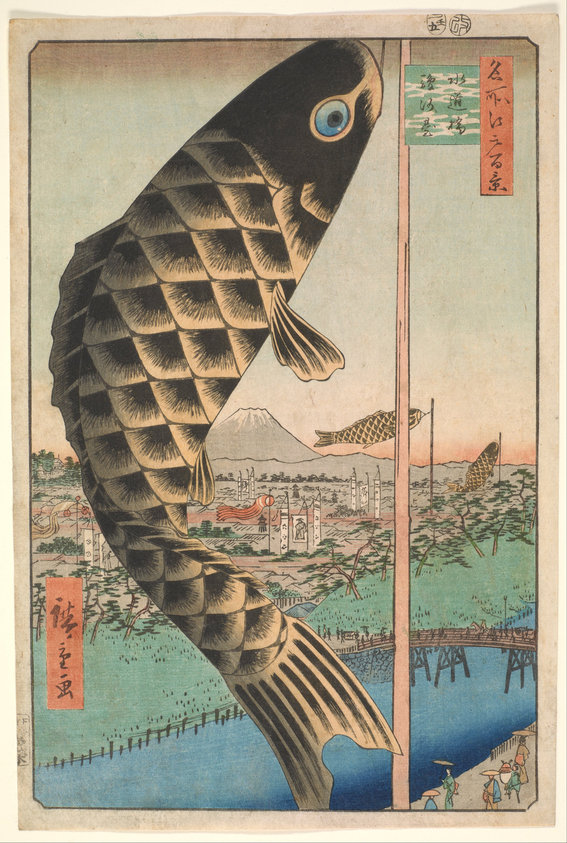
Suido Bridge and Surugadai, from One Hundred Famous Views of Edo
Colors in this work
Details
- Artist
- Utagawa Hiroshige
- Date
- 1857
- Holding institution
- Freer Gallery of Art
- Palette
-
Select a color to find related artworks.
- Image provider
- wikimedia-commons
- License
- Public domain
- Credit
- Freer Gallery of Art
Art Genome Taxonomy
10 tags
Subject Matter
-
Cityscapes and City Scenes Metadata · 98%
The title identifies a view of Edo, and the image presents an inhabited urban setting with bridges, waterways, buildings, and distant Mount Fuji-like terrain.
-
Landscapes and Waterscapes Visual · 97%
Water occupies much of the lower portion of the composition, with bridges, shorelines, and reflected or open blue areas structuring the scene.
-
Text Visual · 99%
Vertical Japanese inscriptions and colored cartouches are visibly integrated into the print at the left and upper-right edges.
Styles and Movements
-
Ukiyo-e Metadata · 99%
The supplied catalog identifies the work as a Japanese woodblock print by Utagawa Hiroshige from One Hundred Famous Views of Edo, a landmark ukiyo-e series.
Visual Qualities
-
Patterns Visual · 99%
A very large cropped carp streamer dominates the foreground, while several smaller patterned streamers repeat across the distant view.
-
Asymmetrical Visual · 99%
The massive streamer cuts diagonally across the sheet and is strongly offset against the open background, producing an asymmetrical composition.
Medium and Techniques
-
Woodcut and Linocut Metadata · 96%
The catalog classifies the object as a Japanese woodblock print; woodcut-and-linocut is the closest available catalog category for the printmaking process.
-
Art That Plays With Scale Visual · 98%
The foreground streamer is shown at an extreme scale in relation to the tiny figures, bridges, buildings, and distant streamers, making scale a conspicuous compositional device.
Time Periods
-
19th Century Art Metadata · 100%
The work is dated 1857, placing it in the nineteenth century.
Geographic Regions
-
Japanese Art Both · 99%
The catalog identifies Hiroshige and a view of Edo, while the image visibly uses Japanese inscriptions, architecture, clothing, and pictorial conventions.
Source & rights
Utagawa Hiroshige. 4wHcySD213IaJw at Google Cultural Institute maximum zoom level
High-resolution sources
- Original image ↗ 2,826 × 4,201 · Wikimedia Commons · Availability not yet probed