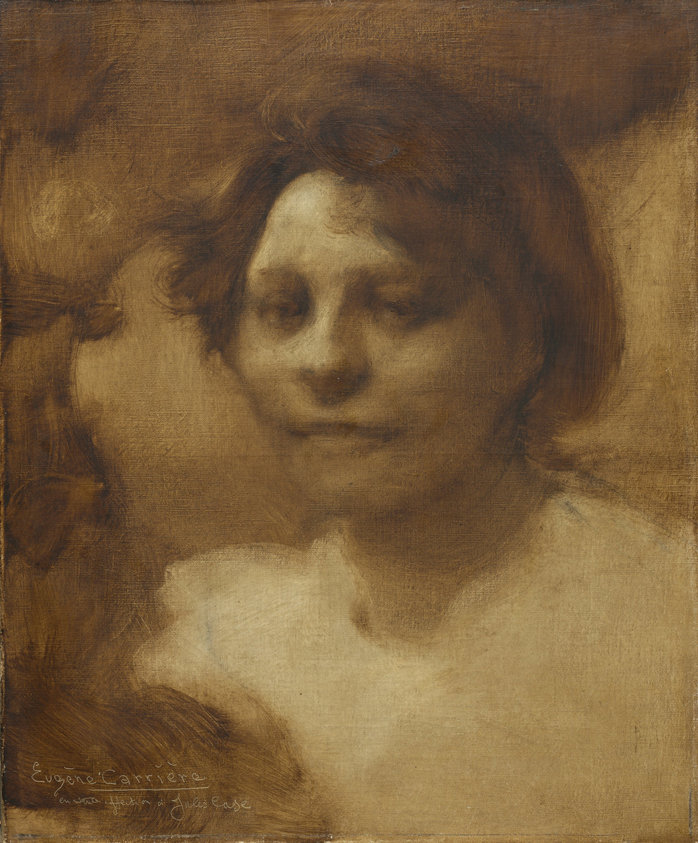
Madame Case
This painting may depict the wife of the artist's close friend, writer Jules Case. In a letter written after her death, Case asked the artist to paint her portrait from an enlarged photograph. "My dear friend," Case wrote, "would you preserve the only face which, from now on, can bring me some little joy, if one can use this word for a sentiment mixed with so much suffering." Carrière emphasized the poetic mood by placing the shadowy figure in a vague, dreamlike space. Known for his evocative paintings of women and children, Eugène Carrière was loosely associated with the French Symbolist movement, which aimed at expressing inner, spiritual life and emotions rather than the outward appearance of physical reality.
Colors in this work
Details
- Medium
- oil on fabric
- Dimensions
- unframed: height 0.462 m, width 0.381 m
- Department
- Modern European Painting and Sculpture
- Holding institution
- Cleveland Museum of Art
- Palette
-
Select a color to find related artworks.
- Image provider
- cleveland-museum-of-art
- License
- CC0-1.0
- Credit
- Mr. and Mrs. William H. Marlatt Fund
Art Genome Taxonomy
9 tags
Subject Matter
-
Individual Portrait Both · 99%
The museum identifies the work as a portrait of Madame Case, and the image centers on one closely cropped human sitter.
-
Face Visual · 99%
The face is the dominant and most legible feature of the composition, with the eyes, nose, mouth, and forehead emerging from surrounding shadow.
-
Mourning and Commemoration Both · 87%
The museum states that the portrait may have been commissioned after the sitter’s death to preserve her face, while the image’s subdued, shadowed treatment supports a commemorative reading.
Styles and Movements
-
Symbolism Metadata · 82%
The museum describes Carrière as loosely associated with the French Symbolist movement and characterizes the work as emphasizing poetic mood and inner emotion over literal physical description.
Visual Qualities
-
Blurred Visual · 99%
Edges of the face, hair, shoulders, and surrounding field are extensively softened, creating an indistinct, hazy appearance.
-
Earth Tones Visual · 99%
The visible palette is dominated by brown, umber, ocher, and muted cream tones characteristic of an earthy, subdued color range.
Medium and Techniques
-
Oil Painting Metadata · 99%
The Cleveland Museum of Art specifies the medium as oil on fabric.
Time Periods
-
1900 - 1917 Art Metadata · 98%
The museum dates the work to after September 1900, probably summer 1901, placing it within the 1900–1917 period.
Geographic Regions
-
French Art Metadata · 99%
The artist is identified as French, and the place of origin is given as France.
Source & rights
Eugène Carrière (French, 1849–1906). Madame Case. Cleveland Museum of Art.
High-resolution sources
- Original TIFF ↗ 4,807 × 5,803 · Cleveland Museum Of Art · Available