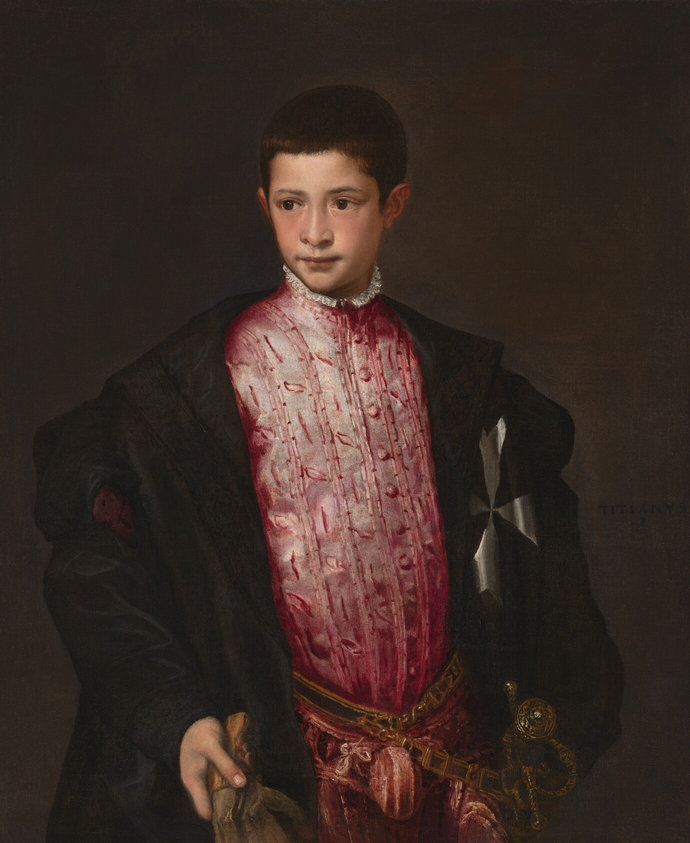
Ranuccio Farnese
Shown from the hips up, a young boy with pale, peachy skin wears a voluminous, black cloak that nearly falls off his shoulders over a rose-pink tunic, with a sword hanging from one hip in this vertical portrait painting. His body is angled slightly to our right, and he looks off to our left with dark brown eyes under gently arched brows. He has a wide nose, and his pink lips are closed with the corners pulled slightly back. His skin is smooth and his cheeks slightly flushed. His dark brown hair is cut close and comes to a point in front of his ears. His tunic is painted with dusky pink highlights against wine-red to suggest a sheen across a vertically striped, leafy pattern. The garment has a high neck lined with a white ruffle and has a row of buttons down the front. His black coat has wide lapels that reach beyond his shoulders, and the puffy sleeves gather on his arms. The coat has a silvery-white cross over the chest to our right. The left and right arms of the cross are lost in the folds but the arms at the top and bottom are forked at the ends. The boy’s pine-green belt is edged with gold, and the hilt of the sword is angled toward us on his left hip, to our right. He holds one fawn-brown glove in his right hand, to our left, and his other arm disappears behind the folds of his coat. The background is deep olive green, almost brown. The artist signed the painting with dark paint near the right edge of the canvas near the boy’s shoulder, “TITANVS F.”
Colors in this work
Details
- Artist
- Titian
- Date
- 1541-1542
- Medium
- oil on canvas
- Dimensions
- overall: 89.7 x 73.6 cm (35 5/16 x 29 in.) framed: 123.83 × 108.9 × 9.53 cm (48 3/4 × 42 7/8 × 3 3/4 in.)
- Department
- CIS-R
- Holding institution
- National Gallery of Art
- Palette
-
Select a color to find related artworks.
- Image provider
- national-gallery-of-art
- License
- CC0-1.0
- Credit
- Samuel H. Kress Collection
Art Genome Taxonomy
6 tags
Subject Matter
-
Individual Portrait Both · 99%
The title identifies the sitter as Ranuccio Farnese, and the image depicts one individual occupying the portrait format alone.
-
Childhood Both · 98%
The catalog describes the sitter as a young boy, and the image visibly shows a youthful figure.
Visual Qualities
-
Dark Colors Visual · 97%
Black, deep brown, olive, wine-red, and dusky pink dominate the composition, with limited light accents on the face, ruff, hand, belt, and sword fittings.
Medium and Techniques
-
Oil Painting Metadata · 100%
The National Gallery of Art catalogs the work as oil on canvas.
-
Chiaroscuro Visual · 84%
The face and selected costume details are modeled with concentrated illumination against a substantially darker background and cloak, producing a pronounced light-dark effect.
Time Periods
-
16th Century Art Metadata · 100%
The catalog dates the work to 1541–1542, placing it in the sixteenth century.
Source & rights
Titian. Ranuccio Farnese. Courtesy National Gallery of Art, Washington.
High-resolution sources
- IIIF image service ↗ 28,585 × 34,917 · National Gallery Of Art · Available