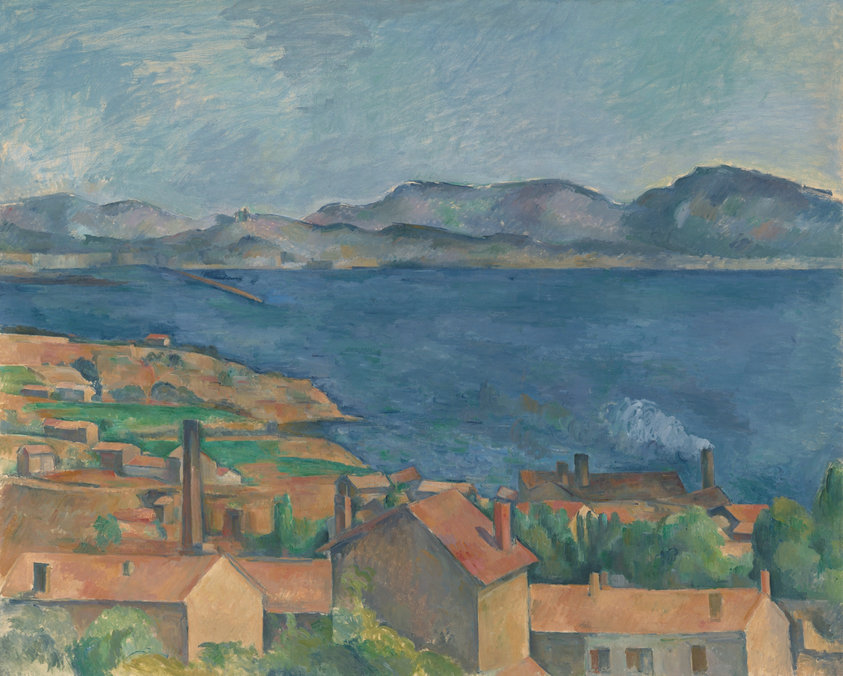
The Bay of Marseille, Seen from L'Estaque
In a letter to his friend and teacher Camille Pissarro, Paul Cézanne compared the view of the sea from L’Estaque to a playing card, with its simple shapes and colors. The landscape’s configuration and color fascinated him. This painting is one of more than a dozen such vistas created by the artist during the 1880s. Cézanne divided the canvas into four zones—architecture, water, mountain, and sky. Although these four elements are seen repeatedly in Impressionist paintings, Cézanne’s work is very different from that of his fellow artists. Whereas their primary purpose was to record the transient effects of light, Cézanne was interested in the underlying structure and composition of the views he painted. Filling the canvas with shapes defined by strong, contrasting colors and a complex grid of horizontal, vertical, and diagonal lines, he created a highly compact, dynamic pattern of water, sky, land, and village that at once refers back to traditionally structured landscape paintings and looks forward to the innovations of Cubism. Using blocklike brushstrokes to build the space, Cézanne created a composition that seems both two- and three-dimensional. Not locked tightly in place, his forms appear to touch and shift continually, creating a sense of volume and space that strengthens the composition and brings it to life.
Colors in this work
Details
- Artist
- Paul Cezanne
- Date
- c. 1885
- Medium
- Oil on canvas
- Dimensions
- 80.2 × 100.6 cm (31 5/8 × 39 5/8 in.); Framed: 107.4 × 127.4 × 10.5 cm (42 1/4 × 50 1/8 × 4 1/8 in.)
- Origin
- France
- Department
- Painting and Sculpture of Europe
- Holding institution
- Art Institute of Chicago
- Palette
-
Select a color to find related artworks.
- Image provider
- art-institute-chicago
- License
- CC0-1.0
- Credit
- Mr. and Mrs. Martin A. Ryerson Collection
Art Genome Taxonomy
10 tags
Subject Matter
-
Landscapes Both · 99%
The image depicts a broad natural view composed of a shoreline settlement, bay, mountains, and sky; the catalog identifies the work as a landscape.
-
Waterscapes Both · 99%
A wide expanse of blue-green sea occupies the middle of the composition, and the catalog identifies the subject as the sea, water, and a coastal scene.
-
Cityscapes and City Scenes Both · 98%
Clustered buildings and rooftops occupy the foreground and shoreline; the catalog lists townscapes and towns as subjects.
Styles and Movements
-
Post-Impressionism Both · 99%
The catalog identifies the style as Post-Impressionism, while the image shows visible brushwork and a structured yet non-academic treatment of landscape.
Visual Qualities
-
Geometric Both · 91%
The composition uses simplified, blocklike passages and repeated angular planes in the roofs, shoreline, and mountain contours; the catalog describes simple shapes, strong contrasting colors, and a structured grid.
-
Linear Forms Both · 95%
Horizontal bands of sky, mountain, shore, and water are crossed by vertical chimneys and diagonal rooflines and land contours; the catalog explicitly describes a complex grid of horizontal, vertical, and diagonal lines.
Medium and Techniques
-
Oil Painting Metadata · 100%
The catalog specifies the medium as oil on canvas.
-
Large Brushstrokes/Loose Brushwork Both · 94%
The image visibly retains directional, blocklike brushwork across the sky, mountains, water, and buildings, and the catalog specifically describes blocklike brushstrokes used to build the space.
Time Periods
-
19th Century Art Metadata · 99%
The work is dated circa 1885, placing it within the nineteenth century.
Geographic Regions
-
French Art Metadata · 100%
The catalog identifies Cézanne as French and gives France as the place of origin.
Source & rights
Paul Cezanne. The Bay of Marseille, Seen from L'Estaque. The Art Institute of Chicago.
High-resolution sources
- IIIF image service ↗ 1,686 × 1,351 · Art Institute Chicago · Availability not yet probed