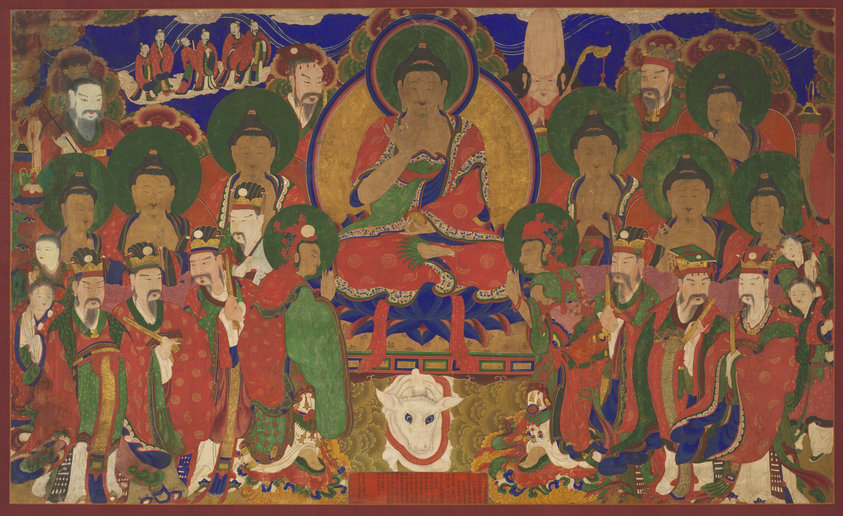
The Assembly of Tejaprabha Buddha
The main deity seated at the center is Tejaprabha, the Buddha of Radiant Light. Blazing beams of light emanating from its celestial body are this deity’s weapon to crush all kinds of calamities. Coincidently, when this painting was created, Korea was experiencing a height of foreign military aggressions, including invasions by the French (1866) and the US (1871). The inscription at the bottom center states that a group of ladies from the royal court commissioned the scroll to wish for the well-being of their families. During the late Joseon dynasty, Korean women became largely marginalized. Nevertheless, they remained important patrons of Buddhist art and architecture, voicing their concerns for their country and families in peril.
Colors in this work
Details
- Artist
- Unknown artist
- Date
- 1878
- Dimensions
- overall: height 2.23 m, width 2.264 m; painting only: height 1.265 m, width 2.108 m; inscription only: height 0.357 m, width 0.081 m; overall with knobs: height 2.23 m, width 2.413 m
- Department
- Korean Art
- Holding institution
- Cleveland Museum of Art
- Palette
-
Select a color to find related artworks.
- Image provider
- cleveland-museum-of-art
- License
- CC0-1.0
- Credit
- Gift of Mitsuru Tajima
Art Genome Taxonomy
12 tags
Subject Matter
-
Deities and Holy Figures Both · 99%
A central haloed sacred figure and numerous surrounding religious figures are clearly visible; the museum identifies the central figure as Tejaprabha Buddha.
Visual Qualities
-
Dense Composition Visual · 99%
The pictorial field is densely filled with overlapping figures, halos, clouds, garments, ornaments, and patterned surfaces, leaving little open space.
-
Symmetrical Visual · 92%
The composition is organized around a strong central axis, with repeated halos and groups of figures balanced on either side of the central Buddha.
-
Bright and Vivid Colors Visual · 97%
Deep blue, saturated red, green, white, ochre, and gold-toned areas create a vivid, high-contrast palette.
-
Highly Ornamented Visual · 97%
The robes, halos, clouds, borders, and ritual attributes display extensive decorative patterning.
-
Patterns Visual · 95%
Repeated motifs appear in the patterned robes, cloud forms, halos, floral details, and decorative borders.
Medium and Techniques
-
Traditional Scroll Painting Metadata · 99%
The museum records the medium as a hanging scroll executed in ink, color, and gold on silk.
-
Painting Metadata · 99%
The catalog classifies the object as a painting.
Time Periods
-
19th Century Art Metadata · 99%
The work is dated 1878, placing it in the nineteenth century.
Geographic Regions
-
Korean Art Metadata · 99%
The work is classified by the Cleveland Museum of Art as Korean Art and its place of origin is recorded as Korea during the Joseon dynasty.
Materials
-
Gold Metadata · 98%
Gold is explicitly listed among the materials in the museum's medium description: ink, color, and gold on silk.
Cultural and Religious Styles
-
Buddhist Art and Architecture Metadata · 99%
The museum identifies the central deity as Tejaprabha Buddha and describes the work as a Buddhist painting commissioned for devotional protection and family well-being.
Source & rights
Unknown artist. The Assembly of Tejaprabha Buddha. Cleveland Museum of Art.
High-resolution sources
- Original TIFF ↗ 7,553 × 4,622 · Cleveland Museum Of Art · Available