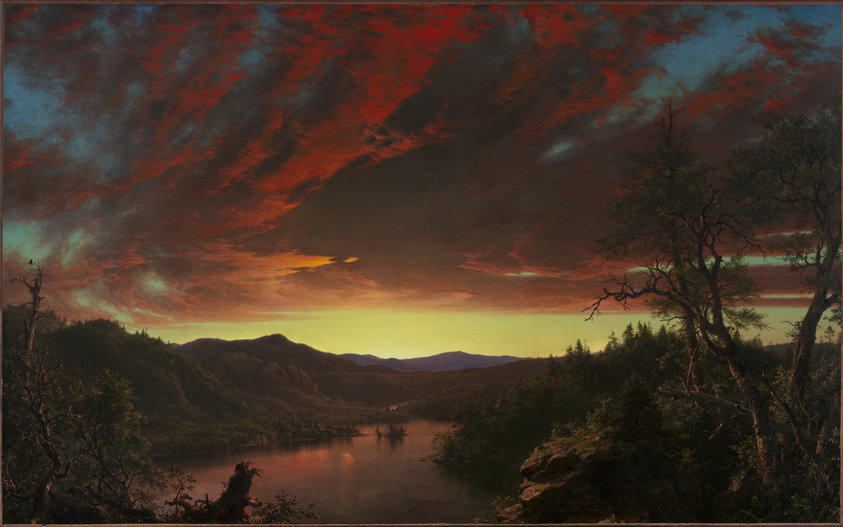
Twilight in the Wilderness
In his New York studio, Church painted this spectacular view of a blazing sunset over wilderness near Mount Katahdin in Maine, which he had sketched during a visit nearly two years earlier. Although Church often extolled the grandeur of American landscape in his work, this painting appears to have additional overtones. Created on the eve of the Civil War, the painting's subject can be interpreted as symbolically evoking the coming conflagration. Church's considerable technical skills and clever showmanship contributed to his fame as the premier artist of his generation. Rather than debut this painting in an annual exhibition with works by other artists as was the custom, Church instead exhibited it by itself at a prestigious art gallery. Coaxed by advance publicity and highly favorable press reviews, several hundred spectators flocked to admire it during its seven-week run.
Colors in this work
Details
- Date
- 1860
- Medium
- oil on canvas
- Dimensions
- framed: height 1.24 m, width 1.85 m, depth 0.13 m; unframed: height 1.016 m, width 1.626 m
- Origin
- America
- Department
- American Painting and Sculpture
- Holding institution
- Cleveland Museum of Art
- Palette
-
Select a color to find related artworks.
- Image provider
- cleveland-museum-of-art
- License
- CC0-1.0
- Credit
- Mr. and Mrs. William H. Marlatt Fund
Art Genome Taxonomy
11 tags
Subject Matter
-
Landscapes Both · 99%
The image presents an expansive natural setting, and the Cleveland Museum of Art identifies the subject as wilderness near Mount Katahdin in Maine.
-
Waterscapes Visual · 97%
A substantial reflective waterway occupies the lower center of the composition and recedes into the landscape.
-
Atmospheric Landscapes Visual · 97%
The painting emphasizes atmospheric recession, layered distant ridges, haze, and the changing effects of sunset light.
-
Light as Subject Visual · 95%
The sunset glow and its reflection are central compositional subjects, concentrating attention along the horizon and waterway.
-
The Sublime Interpretive · 82%
The expansive wilderness, dramatic sky, and overwhelming contrast between darkness and radiance invite an interpretation of nature as emotionally and spiritually powerful.
-
Political Interpretive · 80%
The museum states that, because the painting was created on the eve of the Civil War, its blazing sunset can be interpreted as symbolically evoking the coming conflagration.
Visual Qualities
-
Dark Colors Visual · 99%
The composition is dominated by deep brown, charcoal, blue-violet, and dark green passages, especially in the sky, trees, and foreground.
-
Bright and Vivid Colors Visual · 94%
Saturated red cloud formations and the intensely luminous yellow-green band near the horizon provide vivid accents against the darker landscape.
Medium and Techniques
-
Oil Painting Metadata · 100%
The Cleveland Museum of Art catalogs the work as oil on canvas.
Time Periods
-
19th Century Art Metadata · 100%
The catalog dates the painting to 1860, within the nineteenth century.
Geographic Regions
-
American Art Metadata · 100%
The artist, date, and departmental classification place the work within American art.
Source & rights
Frederic Edwin Church (American, 1826–1900). Twilight in the Wilderness. Cleveland Museum of Art.
High-resolution sources
- Original TIFF ↗ 7,673 × 4,791 · Cleveland Museum Of Art · Available