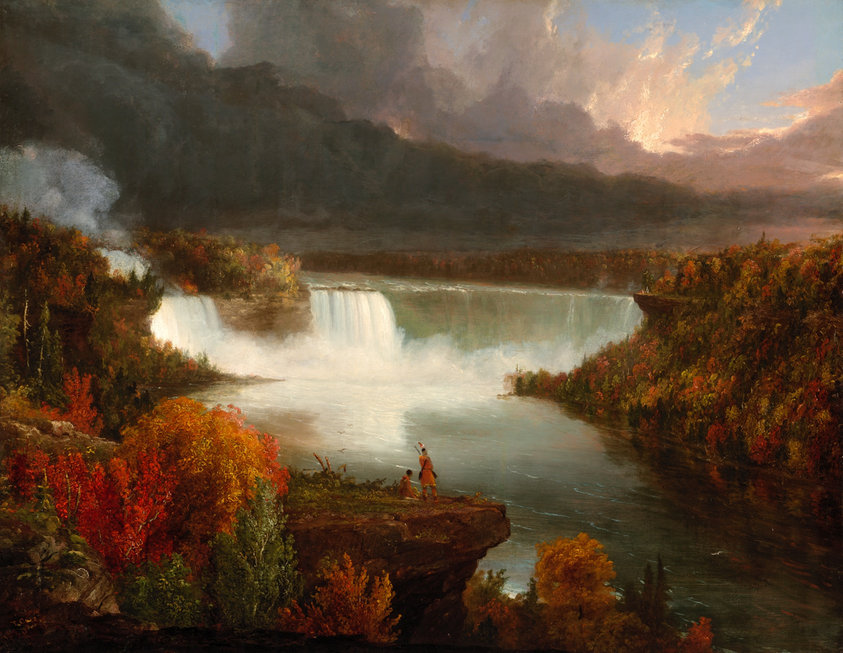
Distant View of Niagara Falls
By the 19th century, Niagara Falls was already an iconic American landscape, nearly verging on mythical. Thomas Cole visited the landmark in May 1829 and composed this romanticized, autumnal scene the following year. In amplifying the natural grandeur of the American landscape, the artist wilfully ommitted the factories, scenic overlooks, and hotels that populated the area in the early 19th century.
Colors in this work
Details
- Artist
- Thomas Cole
- Date
- 1830
- Medium
- Oil on wood panel
- Dimensions
- 47.9 × 60.6 cm (18 7/8 × 23 7/8 in.)
- Origin
- Niagara Falls
- Department
- Arts of the Americas
- Holding institution
- Art Institute of Chicago
- Palette
-
Select a color to find related artworks.
- Image provider
- art-institute-chicago
- License
- CC0-1.0
- Credit
- Friends of American Art Collection
Art Genome Taxonomy
11 tags
Subject Matter
-
Landscapes and Waterscapes Both · 99%
The image is dominated by a river, multiple waterfalls, wooded shores, and receding terrain, while the title and museum subject classification identify the work as a landscape depicting Niagara Falls.
-
Water Visual · 99%
Waterfalls, river, mist, and spray occupy the compositional center and provide the principal focus of the scene.
-
Atmospheric Landscapes Visual · 96%
Layered clouds, mist around the falls, atmospheric distance, and shifting illumination create a pronounced atmospheric effect.
-
Figures in Nature Both · 97%
Two small human figures are visibly situated on the foreground ledge within the expansive natural setting; the museum identifies them as Native American figures.
-
The Sublime Interpretive · 84%
The immense falls and sky, dramatic light, and diminutive human figures support an interpretation of nature as overwhelming and sublime.
-
The Environment Metadata · 86%
The museum explicitly discusses Cole’s concern about industrialism’s environmental impact and the omission of the area’s factories and other infrastructure.
Styles and Movements
-
Romanticism Metadata · 82%
The museum describes the work as a romanticized autumnal scene and emphasizes Cole’s portrayal of the grandeur of the American landscape; the style field itself is not formally populated.
-
19th Century American Art Metadata · 98%
The work was made in 1830 by Thomas Cole, identified in the metadata as an American artist, and is classified within American arts.
Medium and Techniques
-
Oil on Panel Metadata · 99%
The museum records the medium as oil on wood panel.
Time Periods
-
19th Century Art Metadata · 99%
The date of 1830 places the work within nineteenth-century art.
Geographic Regions
-
American Art Metadata · 96%
The museum classifies the work within American arts, identifies Cole as American, and describes the subject as an American landscape.
Source & rights
Thomas Cole. Distant View of Niagara Falls. The Art Institute of Chicago.
High-resolution sources
- IIIF image service ↗ 1,686 × 1,306 · Art Institute Chicago · Availability not yet probed