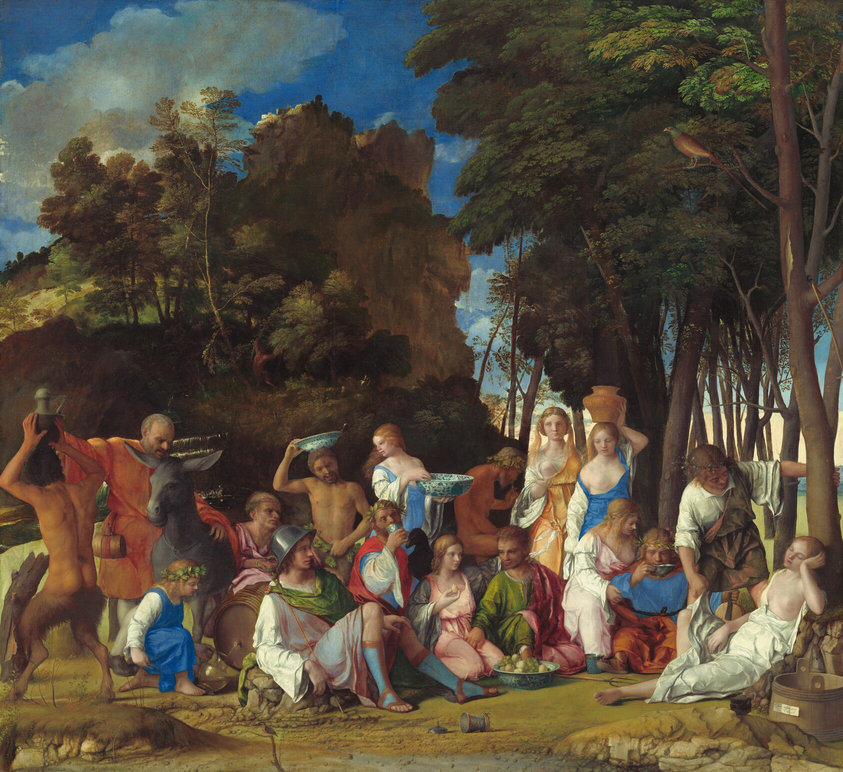
The Feast of the Gods
Six women, eight men, two satyrs, and one child gather in pairs and trios in a loose row that spans the width of this nearly square painting. They are set within a landscape with craggy rocks, cliffs, and trees. Most of the people face us, and the men, women, and child have pale skin. The two satyrs have men’s torsos and furry goat’s legs, and they have darker, olive complexions. Most of the men wear voluminous, knee-length togas wrapped in short robes in shades of white, topaz blue, grass green, coral orange, or rose pink. Most of the women wear long, dress-like garments in tones of shell pink, apricot orange, or lapis blue over white sleeves. For all but one woman, their garments have fallen off one shoulder to reveal a round, firm breast. Several objects are strewn on the rocky, dirt ground in front of the group, including a wide, wooden bucket with a piece of paper affixed to its front to our right, a glass goblet, a pitchfork, a large blue and white ceramic dish filled with grapes and small yellow fruits, and an overturned cup near the center. Cliff-like, craggy rocks rise steeply behind the group to our left, filling much of the sky opposite a tall grove of leafy, dark green trees to our right. A few puffy white clouds float across the vivid blue sky. The slip of paper on the barrel has been inscribed, “joannes bellinus venetus p MDXIIII.”
Colors in this work
Details
- Artist
- Giovanni Bellini; Titian
- Date
- 1514/1529
- Medium
- oil on canvas
- Dimensions
- overall: 170.2 x 188 cm (67 x 74 in.) framed: 203.8 x 218.4 x 7.6 cm (80 1/4 x 86 x 3 in.)
- Department
- CIS-R
- Holding institution
- National Gallery of Art
- Palette
-
Select a color to find related artworks.
- Image provider
- national-gallery-of-art
- License
- CC0-1.0
- Credit
- Widener Collection
Art Genome Taxonomy
12 tags
Subject Matter
-
Classical Mythology Both · 98%
The title identifies a feast of gods, while the image includes idealized classical figures and two figures with human torsos and furry goat legs identified in the catalog as satyrs.
-
Figures in Nature Both · 98%
The catalog describes figures gathered within a landscape, and the image visibly places them among trees, cliffs, rocks, and open sky.
-
Landscapes Both · 99%
Craggy cliffs, wooded terrain, distant openings, and a prominent sky make landscape a major compositional element.
-
Parties and Celebrations Both · 97%
The title names a feast, and the image shows a large convivial gathering accompanied by food, cups, bowls, and other serving vessels.
-
Human Figure Visual · 99%
Numerous human bodies are prominently depicted in seated, reclining, standing, and interacting poses.
-
Nude Visual · 96%
Several female figures have exposed breasts, and other figures are partially or largely unclothed.
-
Animals Both · 98%
A donkey appears at the left, and the catalog identifies two satyrs whose bodies combine human and animal features.
-
Food Both · 96%
The foreground visibly contains grapes, small yellow fruits, bowls, and drinking vessels; the catalog specifically describes a dish filled with grapes and fruit.
Styles and Movements
-
Renaissance Art Interpretive · 90%
The date, artists, idealized human figures, mythological subject, and developed natural setting are consistent with Renaissance art, although the supplied catalog does not provide a formal style classification.
Visual Qualities
-
Bright and Vivid Colors Visual · 92%
The image uses saturated blue, coral, rose, orange, green, and white garments against darker foliage and earth tones.
Medium and Techniques
-
Oil Painting Metadata · 99%
The National Gallery of Art identifies the medium as oil on canvas.
Time Periods
-
16th Century Art Metadata · 99%
The catalog dates the work 1514/1529, placing it in the sixteenth century.
Source & rights
Giovanni Bellini and Titian. The Feast of the Gods. Courtesy National Gallery of Art, Washington.
High-resolution sources
- IIIF image service ↗ 26,900 × 24,642 · National Gallery Of Art · Available