Apollo and Marsyas
Sienese 16th Century Bartolomeo di David
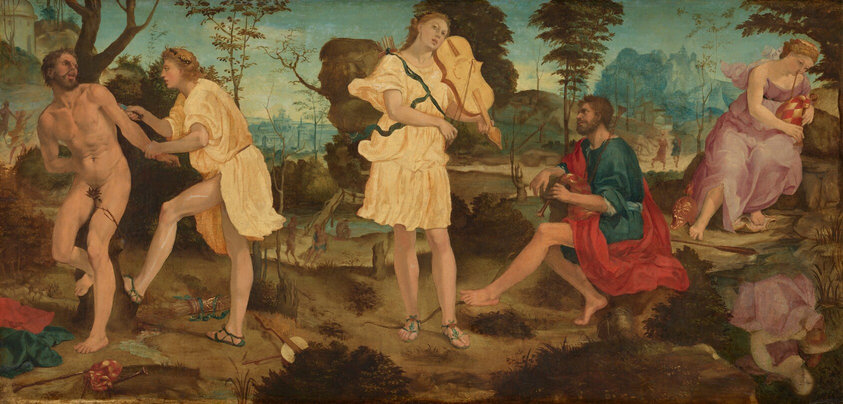
A young person with dark blond hair, wearing a knee-length, pale yellow toga, stands playing a violin-like instrument at the center of this long, horizontal landscape painting. A pair of people are to the left and another pair to the right. Most of the people have pale skin, and two of the men have slightly darker, tanned complexions. The person at the center, Apollo, nearly spans the height of the painting. He tips his head back and to our right, toward the instrument on his shoulder, and he looks at us with dark eyes, lips parted. With his other hand, he holds a bow to the instrument’s strings. A dark green wreath of leaves encircles his long hair, and a quiver of arrows is tied with a pine-green ribbon across his chest. His legs are bare, and he wears sandals. An archer’s bow lies on the dirt ground behind his feet. To our right, a man with a dark beard and hair, Marsyas, sits on a rock playing a bagpipe. He faces our left in profile, looking up at Apollo, and he wears a red robe over a royal-blue tunic. Behind him and to our right, near the edge of the panel, a blond woman wearing a rose-pink dress also plays a bagpipe as she looks down onto her reflection in a pool below, in the lower right corner of the composition. Her left foot rests on a white and gold shield, and a golden helmet sits next to her other foot. Marsyas and Apollo appear again as a pair to our left. Marsyas is now nude and tied to a tree, his body facing us, near the left edge of the panel. His mouth is open and he looks toward Apollo, who approaches from our right. Apollo grabs Marsyas’s left wrist, on our right, and holds a knife to the nude man’s upper arm. The set of bagpipes, the quiver of arrows, Marsyas’s clothing, and Apollo’s instrument are strewn on the ground around the men’s feet. The scenes take place in a rocky landscape with dark green shrubs along the bottom edge of the composition and behind the people. A river runs across the land beyond, and people walk along dirt roads in the distance. Trees, craggy cliffs, and a town in the deep distance are painted with icy blue under a blue sky.
Colors in this work
Details
- Date
- c. 1540
- Medium
- oil on panel
- Dimensions
- overall: 55.9 x 117 cm (22 x 46 1/16 in.) framed: 75.6 x 136.2 x 8.6 cm (29 3/4 x 53 5/8 x 3 3/8 in.)
- Department
- CIS-R
- Holding institution
- National Gallery of Art
- Palette
-
Select a color to find related artworks.
- Image provider
- national-gallery-of-art
- License
- CC0-1.0
- Credit
- Samuel H. Kress Collection
Art Genome Taxonomy
11 tags
Subject Matter
-
Classical Mythology Both · 99%
The title and museum description identify Apollo and Marsyas, while the image depicts Apollo with a wreath, quiver, bow, and musical instrument alongside Marsyas.
-
Narrative Both · 98%
The repeated appearances of Apollo and Marsyas across the landscape depict successive episodes of their musical contest and confrontation.
-
Landscapes and Waterscapes Both · 97%
The figures and episodes are set within an extensive wooded landscape containing a river or pool, roads, cliffs, trees, and a distant town.
-
Human Figure Both · 97%
Several full-length human figures occupy the foreground and middle distance of the composition.
-
Nude Both · 99%
Marsyas is visibly depicted nude and restrained at the left side of the panel.
-
Related to Music Both · 97%
Apollo and Marsyas, along with the woman at right, are associated with bowed or wind instruments; the catalog specifically describes a violin-like instrument and bagpipes.
-
Violence Both · 94%
At left, Apollo restrains the nude Marsyas and holds a knife against his upper arm, presenting an explicit threat of bodily harm.
-
Reflections Both · 86%
The woman at the far right looks toward her reflection in a pool, which is visibly incorporated into the lower-right portion of the scene.
Medium and Techniques
-
Oil on Panel Metadata · 99%
The National Gallery of Art identifies the medium as oil on panel.
Time Periods
-
16th Century Art Metadata · 99%
The museum dates the work to circa 1540, placing it in the sixteenth century.
Geographic Regions
-
Italian Art Metadata · 84%
The catalog attribution is Sienese 16th Century, possibly Bartolomeo di David, supporting an Italian regional context while leaving the individual attribution uncertain.
Source & rights
Sienese 16th Century, possibly Bartolomeo di David. Apollo and Marsyas. Courtesy National Gallery of Art, Washington.
High-resolution sources
- IIIF image service ↗ 45,034 × 21,570 · National Gallery Of Art · Available