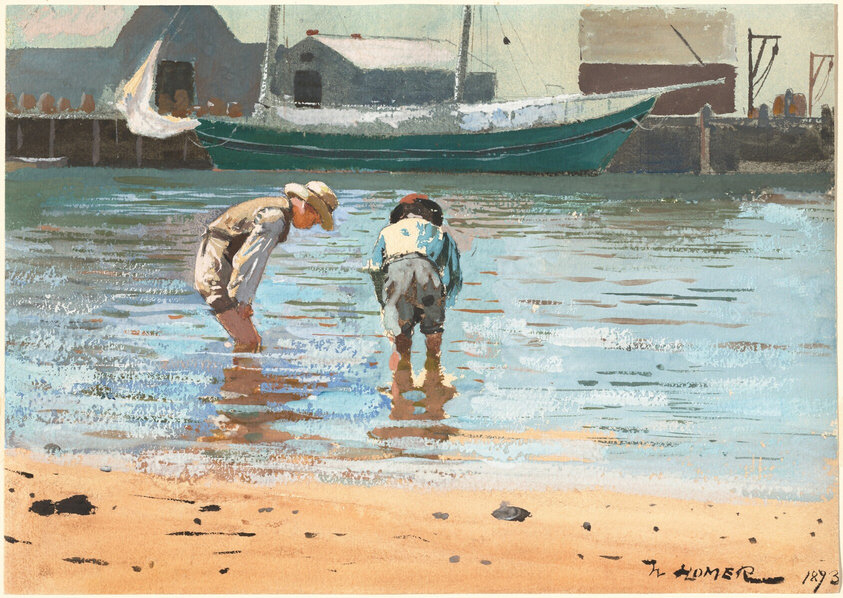
Boys Wading
Two pale-skinned boys with their pants rolled up stand knee-deep in crystal-blue water in this horizontal watercolor on paper. Gray pebbles are scattered across a stretch of peachy-tan sand along the bottom of the sheet. Water ripples gently across a channel to a sailboat docked in front of dark gray warehouses and a brown building lining a pier. The boat is robin’s egg blue with a navy stripe across its center. In the distance to our right, two cranes for loading cargo are silhouetted against the pale blue sky that spans the top fifth of the composition. Near the beach, the two boys plant on their fists on their knees to peer down into the water. One boy stands with his back to us in the center of the composition. The other is to our left. He stoops, facing our right in profile. Both wear brimmed hats, long-sleeved shirts, and the boy on our left wears a vest in tones of peanut brown, cream and bright white, straw yellow, and nickel gray. Strokes of opaque white and sparkling blue sweep across the water so the texture of the paper shows through. The artist signed and dated the watercolor in the lower right: “W HOMER 1873.”
Colors in this work
Details
- Artist
- Winslow Homer
- Date
- 1873
- Dimensions
- sheet: 24.77 × 34.93 cm (9 3/4 × 13 3/4 in.)
- Department
- CG-W
- Holding institution
- National Gallery of Art
- Palette
-
Select a color to find related artworks.
- Image provider
- national-gallery-of-art
- License
- CC0-1.0
- Credit
- Collection of Mr. and Mrs. Paul Mellon
Art Genome Taxonomy
11 tags
Subject Matter
-
Childhood Both · 99%
Two boys are the central figures, and the museum description explicitly identifies the subjects as boys wading.
-
Scenes of Everyday Life Both · 93%
The work records an ordinary activity—two boys wading and bending to examine the shallow water—within an observed outdoor setting.
-
Water Both · 99%
Water occupies most of the composition, with extensive ripples, reflections, and visible shallow-water effects.
-
Waterscapes Both · 97%
The image presents a broad waterfront scene centered on a channel, shoreline, boat, pier, and reflective water; the catalog describes it as a channel with a docked sailboat and waterfront structures.
-
Modes of Transportation Both · 92%
A large boat is prominently visible behind the figures, with a pier and harbor structures supporting the transportation setting.
-
Industry Both · 88%
Warehouses, a pier, and two cargo-loading cranes are visible in the background, establishing an industrial or working-waterfront context.
Medium and Techniques
-
Drawing Metadata · 99%
The museum classifies the work as a drawing and identifies its medium as watercolor and gouache over graphite on wove paper.
-
Watercolor Both · 99%
The catalog identifies watercolor, and the image visibly contains translucent washes and fluid blue passages across the water and sky.
-
Work on Paper Metadata · 99%
The work is cataloged as watercolor and gouache over graphite on wove paper, with sheet dimensions rather than a canvas or panel support.
-
Stains/Washes Visual · 92%
Broad, broken washes and layered horizontal passages are visible across the water, with the paper surface showing through between opaque and translucent marks.
Time Periods
-
19th Century Art Metadata · 99%
The museum dates the work to 1873, placing it within the nineteenth century.
Source & rights
Winslow Homer. Boys Wading. Courtesy National Gallery of Art, Washington.
High-resolution sources
- IIIF image service ↗ 7,182 × 5,092 · National Gallery Of Art · Available