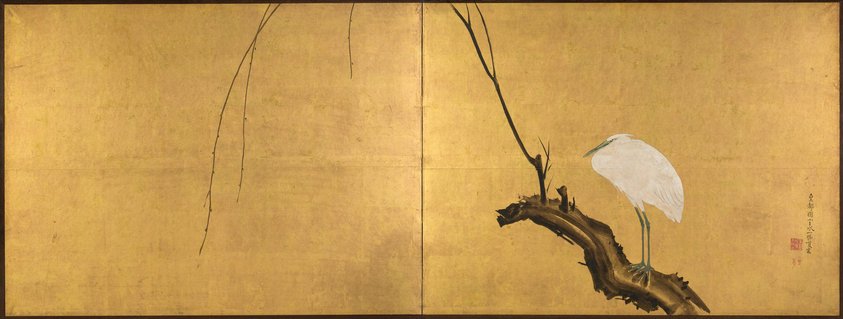
Heron on a Willow Branch
Okyo was the most influential painter and teacher of his time in Kyoto. His mastery of brush and ink found expression in a variety of Chinese and Japanese subjects, painting styles, and formats. This depiction of a heron on a willow branch is done in a classical Japanese painting (yamato-e) style, utilizing flat areas of colorful pigments set against an expansive background with little or no spatial depth.
Colors in this work
Details
- Date
- late 1700s
- Dimensions
- image: height 0.694 m, width 1.85 m
- Department
- Japanese Art
- Holding institution
- Cleveland Museum of Art
- Palette
-
Select a color to find related artworks.
- Image provider
- cleveland-museum-of-art
- License
- CC0-1.0
- Credit
- Bequest of Mrs. A. Dean Perry
Art Genome Taxonomy
9 tags
Subject Matter
-
Animals Both · 100%
A heron is the clearly visible subject, and the catalog title identifies the work as Heron on a Willow Branch.
Visual Qualities
-
Flatness Both · 98%
The museum describes the yamato-e painting as using flat areas of colorful pigments against an expansive background with little or no spatial depth; the image visibly has a shallow, flattened pictorial field.
-
Asymmetrical Visual · 99%
The heron and substantial branch are concentrated on the right, while the left side remains largely open, producing a distinctly asymmetrical arrangement.
-
Sparse Both · 97%
The composition contains only a heron, branch, and a few thin hanging limbs against a broad, largely uninterrupted ground; the catalog also emphasizes the expansive background.
Medium and Techniques
-
Painting Both · 99%
The work is visibly a painted image, and the museum classifies it as Painting; the catalog identifies ink and color on silk.
-
Screen Format Both · 100%
The work is explicitly identified as a two-panel folding screen, and the central panel seam and broad horizontal format are visible in the image.
Time Periods
-
18th Century Art Metadata · 98%
The museum dates the work to the late 1700s, with catalog dates of 1775–1799.
Geographic Regions
-
Japanese Art Metadata · 99%
The catalog identifies the place of origin as Japan and the work as Edo-period Japanese art.
Materials
-
Gold Both · 99%
The ground is visibly gold-toned, and gold is listed among the cataloged materials: ink, color, lacquer, and gold on silk.
Source & rights
Maruyama Ōkyo (Japanese, 1733–1795). Heron on a Willow Branch. Cleveland Museum of Art.
High-resolution sources
- Original TIFF ↗ 13,713 × 5,180 · Cleveland Museum Of Art · Available