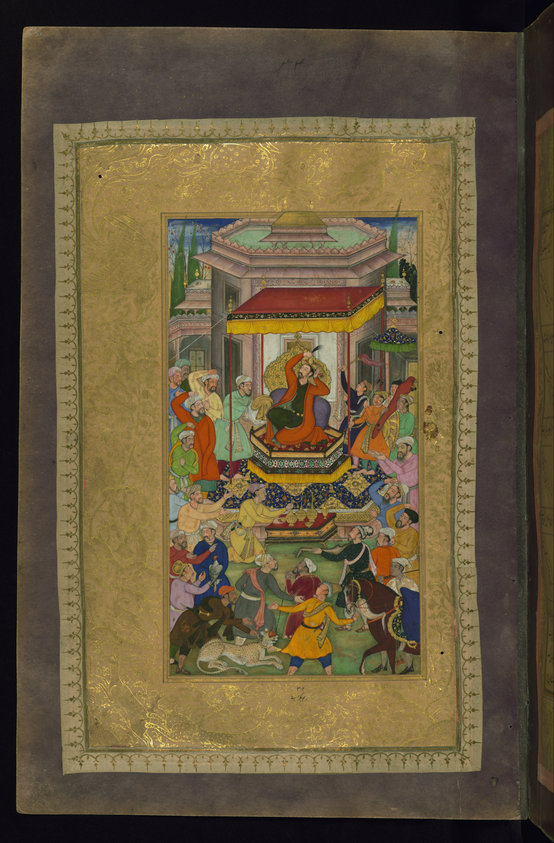
Alexander the Great Enthroned at Persepolis
Unknown artist (work associated with Nizami Ganjavi)
Colors in this work
Details
- Date
- 1595
- Holding institution
- Walters Art Museum
- Palette
-
Select a color to find related artworks.
- Image provider
- wikimedia-commons
- License
- Public domain
- Credit
- Walters Art Museum
Art Genome Taxonomy
12 tags
Subject Matter
-
Narrative Both · 98%
The title identifies an enthronement episode, and the image depicts a staged gathering organized around a central enthroned figure.
-
Royalty and Aristocracy Both · 96%
The title names Alexander the Great, and the image centers a courtly figure seated on an elevated throne beneath an elaborate canopy.
-
Human Figure Visual · 99%
Numerous human figures in varied garments and poses occupy the pavilion and foreground.
-
Animals Visual · 94%
Horses and a spotted animal are visible in the lower portion of the miniature.
Visual Qualities
-
Dense Composition Visual · 99%
The miniature is densely populated with figures, architecture, furnishings, textiles, animals, and ornamental details, with little unoccupied space inside the scene.
-
Highly Ornamented Visual · 99%
Extensive floral and arabesque ornament appears across the surrounding field, borders, canopy, garments, textiles, throne, and architecture.
-
Patterns Visual · 98%
Repeated floral scrolls, patterned fabrics, border motifs, and architectural ornament establish a strongly patterned surface.
-
Flatness Visual · 95%
The scene uses stacked architectural levels, overlapping figures, and a relatively planar arrangement rather than sustained illusionistic recession.
-
Metallic Visual · 87%
The broad surrounding field and numerous fine decorative lines appear strongly gold-colored and reflective in the supplied image, although the precise material is not confirmed.
Medium and Techniques
-
Manuscript Metadata · 99%
The canonical classification identifies the work as manuscript or decorative art, and the image visibly presents a decorated folio with a central miniature.
-
Frontal Perspective Visual · 86%
The main pavilion façade, canopy, and throne are arranged around a predominantly front-facing central axis.
Time Periods
-
16th Century Art Metadata · 99%
The canonical date is 1595, which places the work in the sixteenth century.
Source & rights
Nizami Ganjavi. EwFmdLkQnKrncg at Google Cultural Institute maximum zoom level
High-resolution sources
- Original image ↗ 8,320 × 12,676 · Wikimedia Commons · Availability not yet probed