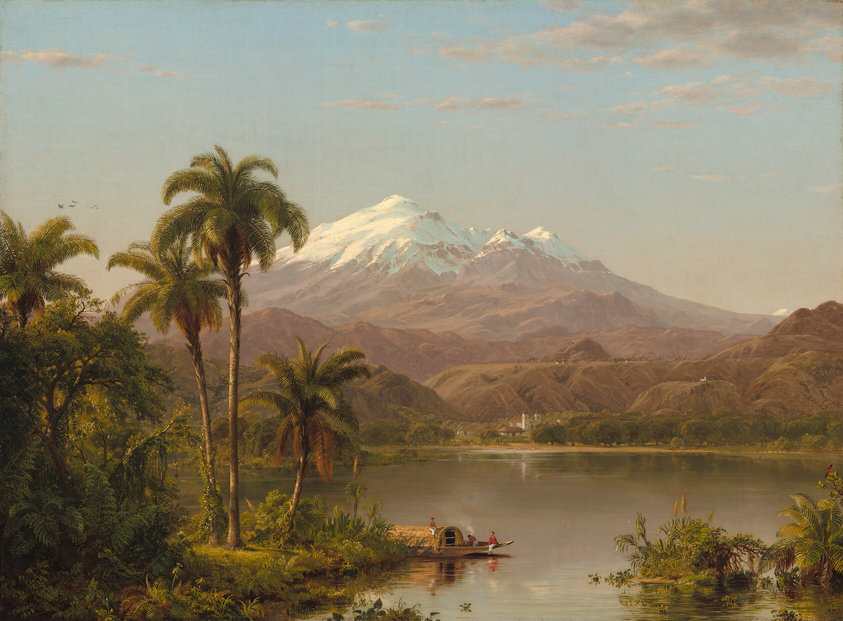
Tamaca Palms
We look across a palm-tree lined river winding into the distance before a monumental, snow-covered mountain at the center of the composition in this horizontal landscape. The spit of land along the riverbank in the lower left corner is filled with lush vegetation, including waving ferns, vines, leafy trees, and palm trees. At the bottom center of the composition, along the shoreline, a boat with a pointed prow is occupied by three people wearing white pants. Two of the men are bare-chested and the third wears a red shirt. The boat is covered with a rounded, hut-like structure and tendrils of white paint, perhaps indicating smoke from a fire, waft up in front of the opening to the structure. The placid river widens beyond the boat and across from us, the distant shore is lined with white buildings with brown thatched roofs and a white church with two spires and a red tile roof. Trees around and beyond the buildings fill in the space before brown hills that eventually lead to the snowy peaks of the central mountain. The earthy moss and sage green and tawny brown of the vegetation and river closer to us fades to pale caramel and pinkish-tan in the hazy distance. A few birds fly across the pale blue sky to our left, and wisps of light gray clouds float in from our right. The artist signed and dated the work in the lower left corner: “Church 1854.”
Colors in this work
Details
- Artist
- Frederic Edwin Church
- Date
- 1854
- Medium
- oil on canvas
- Dimensions
- overall: 67.9 × 91.3 cm (26 3/4 × 35 15/16 in.) framed: 103.5 × 127.6 × 14.6 cm (40 3/4 × 50 1/4 × 5 3/4 in.)
- Department
- CAB
- Holding institution
- National Gallery of Art
- Palette
-
Select a color to find related artworks.
- Image provider
- national-gallery-of-art
- License
- CC0-1.0
- Credit
- Corcoran Collection (Gift of William Wilson Corcoran, 1869)
Art Genome Taxonomy
8 tags
Subject Matter
-
Landscapes and Waterscapes Both · 99%
The museum metadata classifies the work as a horizontal landscape, and the image clearly depicts a broad river, lush vegetation, distant hills, and a monumental mountain.
-
Flora Both · 99%
Palm trees, ferns, vines, and dense leafy vegetation visibly dominate the foreground and shoreline; the catalog specifically describes the work’s palm trees and lush vegetation.
-
Modes of Transportation Both · 99%
A small covered boat with three occupants is clearly visible near the lower center, consistent with the catalog description.
Visual Qualities
-
Highly Detailed Visual · 96%
The foreground foliage, palm fronds, boat, shoreline, buildings, mountain ridges, and water reflections receive extensive fine detail.
-
Earth Tones Visual · 93%
The lower and middle portions of the image are dominated by mossy and sage greens, tawny browns, ochres, muted pinks, and other natural earth colors, balanced by pale blue sky and snow.
Medium and Techniques
-
Long Distance and Deep Distance Visual · 96%
The composition progresses from sharply articulated foreground vegetation through the river and settlement to successive foothills and a hazy mountain range, producing pronounced spatial depth.
-
Oil Painting Metadata · 99%
The National Gallery of Art catalog identifies the medium as oil on canvas.
Time Periods
-
19th Century Art Metadata · 99%
The catalog dates the work to 1854, placing it within the nineteenth century.
Source & rights
Frederic Edwin Church. Tamaca Palms. Courtesy National Gallery of Art, Washington.
High-resolution sources
- IIIF image service ↗ 17,899 × 13,173 · National Gallery Of Art · Available