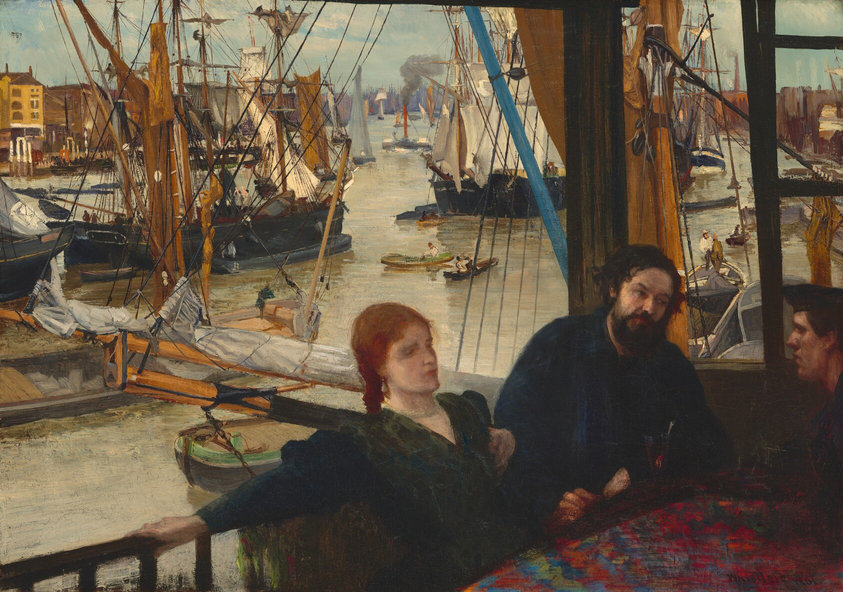
Wapping
We look slightly down at a woman with pale skin and two men with ruddy complexions sitting at a table near a railing overlooking a boat-clogged waterway in this horizontal painting. Only the corner of the table is visible in the lower right corner of the canvas. The woman sits next to one man on the far side of the table, and the third person leans onto the table from our right, along the edge of the composition. The table is covered with a dark, ruby-red, floral cloth. The red-haired woman wears a dark green dress and leans back, extending her right arm along the railing. Her back is to the river below, and she gazes directly ahead, to our right. The dark-haired, bearded man sitting to her left, our right, leans toward the cleanshaven, dark-haired man sitting across from him. That second man wears a cap, and he has a prominent nose and square jaw. Sailboats, rowboats, a steamship, and vessels of every size occupy much of the waterway. Rows of buildings extend along the river to our left and right, and trees line the distant horizon at the center of the painting. The river is a tan color and the pale blue sky is hazy.
Colors in this work
Details
- Artist
- James McNeill Whistler
- Date
- 1860-1864
- Medium
- oil on canvas
- Dimensions
- overall: 72 x 101.8 cm (28 3/8 x 40 1/16 in.) framed: 92.1 x 123.5 x 7.6 cm (36 1/4 x 48 5/8 x 3 in.)
- Department
- CAB
- Holding institution
- National Gallery of Art
- Palette
-
Select a color to find related artworks.
- Image provider
- national-gallery-of-art
- License
- CC0-1.0
- Credit
- John Hay Whitney Collection
Art Genome Taxonomy
11 tags
Subject Matter
-
Waterscapes Visual · 99%
A broad waterway filled with sailing vessels, rowboats, and a steamship occupies the middle and background of the composition.
-
City Scenes Visual · 95%
The scene includes a built waterfront, docks, railings, rows of buildings, and numerous vessels rather than an unpopulated natural landscape.
-
Human Figure Visual · 99%
Three human figures are visible in the foreground, seated together beside the railing and table.
-
Nautical Visual · 99%
The image presents a maritime setting dominated by boats, masts, rigging, docks, and waterborne activity.
-
Haze Visual · 92%
The distant waterway and sky are visibly softened and atmospheric, with reduced clarity toward the horizon.
Visual Qualities
-
Dense Composition Visual · 98%
The harbor is densely occupied by overlapping vessels, masts, ropes, rigging, dock structures, and architectural elements.
-
Linear Forms Visual · 97%
Vertical masts, diagonal ropes, railings, hulls, and dock timbers create an extensive network of linear elements.
-
Earth Tones Visual · 93%
The palette is dominated by muted tan, brown, gray, blue-green, and dark blue tones, with concentrated red accents in the foreground textile.
Medium and Techniques
-
Oil Painting Metadata · 100%
The National Gallery of Art identifies the medium as oil on canvas.
-
Painting Both · 100%
The work is cataloged as a painting, and the image visibly presents painted forms and brushwork on a canvas support.
Time Periods
-
19th Century Art Metadata · 100%
The catalog dates the work to 1860–1864, placing it within the nineteenth century.
Source & rights
James McNeill Whistler. Wapping. Courtesy National Gallery of Art, Washington.
High-resolution sources
- IIIF image service ↗ 26,205 × 18,401 · National Gallery Of Art · Available