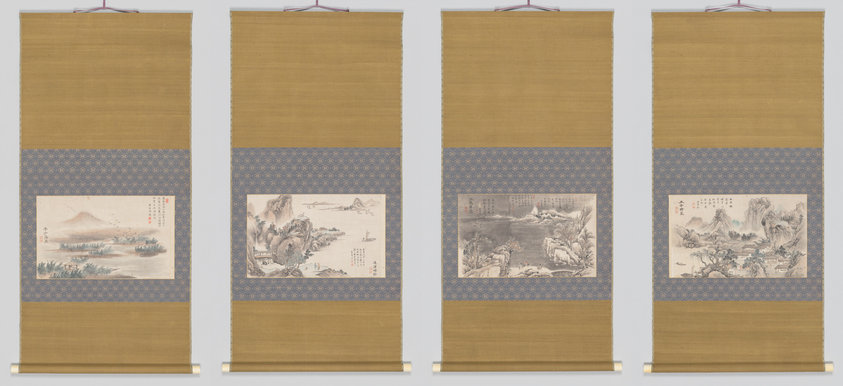
Four Motifs from the Eight Views of Xiao-Xiang
These paintings were part of a set of album leaves representing the Eight Views of Xiao-Xiang, a theme originating in Chinese poetry and painting that spread to both Korea and Japan. Southern China’s Xiao-Xiang area, where the mist-covered banks of the Xiang River created a complex landscape shifting like the moods and minds of people, captured the imaginations of generations of painters and calligraphers. Inscriptions on these works suggest that they were possibly ordered by newly prominent Japanese Confucian scholars.
Colors in this work
Details
- Date
- 1788
- Dimensions
- each mounted: height 1.29 m, width 0.67 m; each painting: height 0.295 m, width 0.49 m
- Department
- Japanese Art
- Holding institution
- Cleveland Museum of Art
- Palette
-
Select a color to find related artworks.
- Image provider
- cleveland-museum-of-art
- License
- CC0-1.0
- Credit
- Andrew R. and Martha Holden Jennings Fund
Art Genome Taxonomy
11 tags
Subject Matter
-
Landscapes Both · 99%
The four central paintings depict mountainous, wooded, and atmospheric scenery, while the catalog identifies the work as part of the Eight Views of Xiao-Xiang landscape theme.
-
Landscapes and Waterscapes Both · 94%
Waterways and water-adjacent settings are visible in the paintings, and the Xiao-Xiang theme is associated with the mist-covered banks of the Xiang River.
-
Atmospheric Landscapes Visual · 96%
Pale washes, veiled mountain forms, and soft spatial recession create atmospheric landscape effects across several panels.
-
Haze Visual · 93%
The scenes repeatedly use light, mist-like passages and subdued transitions between distant landforms and open paper.
-
Engaged with Traditional Chinese Art Metadata · 89%
The catalog states that the Eight Views of Xiao-Xiang theme originated in Chinese poetry and painting before spreading to Korea and Japan.
Medium and Techniques
-
Hanging Scroll Both · 99%
The image shows four vertically oriented scrolls, and the catalog describes four album leaves remounted as hanging scrolls.
-
Painting Metadata · 99%
The catalog classifies the work as painting and specifies ink and color on paper.
-
East Asian Ink-and-Wash Painting Both · 94%
The catalog specifies ink and color on paper, and the image visibly uses ink washes with restrained color in an East Asian landscape-painting format.
Time Periods
-
18th Century Art Metadata · 99%
The work is dated 1788, placing it within the eighteenth century.
Geographic Regions
-
Japanese Art Metadata · 99%
The Cleveland Museum of Art identifies the work as Japanese Art made in Japan during the Edo period.
Materials
-
Use of Paper Metadata · 99%
The catalog identifies the paintings as made on paper.
Source & rights
Tani Bunchō (Japanese, 1763–1841). Four Motifs from the Eight Views of Xiao-Xiang. Cleveland Museum of Art.
High-resolution sources
- Original TIFF ↗ 27,575 × 12,617 · Cleveland Museum Of Art · Available