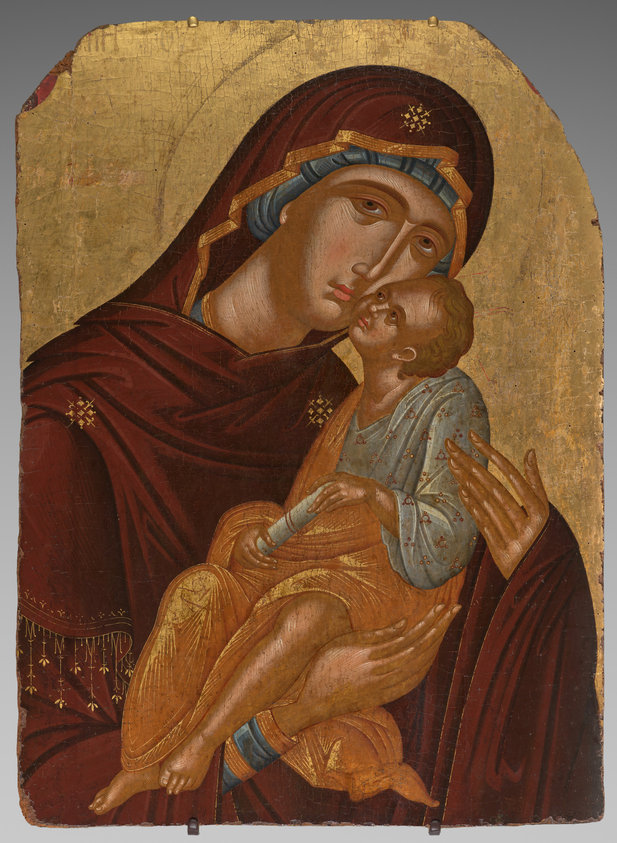
Icon of the Mother of God and Infant Christ (Virgin Eleousa)
Angelos Akotantos (attributed)
This large icon of a tender embrace between the Virgin Mary and Christ likely hung on a Greek Orthodox church’s iconostasis, a screen separating the congregation from the altar-containing sanctuary, which only clergy could enter. A skilled painter of faces and draperies, Angelos Akotantos was among Crete’s most sought-after artists. Based in Byzantium’s artistic center in his hometown of Candia, he painted for imperial clients and beyond. Despite theological differences, Cretan icons of Mary were popular in Ethiopia. In the early 1500s, Emperor Lebna Dengel sent monks Zekre and Pawli to acquire Cretan icons for him. Twenty-nine Cretan icons are still venerated (honored) in Ethiopian churches.
Colors in this work
Details
- Date
- c. 1425–50
- Medium
- tempera and gold on wood
- Dimensions
- unframed: height 0.96 m, width 0.7 m
- Department
- Medieval Art
- Holding institution
- Cleveland Museum of Art
- Palette
-
Select a color to find related artworks.
- Image provider
- cleveland-museum-of-art
- License
- CC0-1.0
- Credit
- Leonard C. Hanna Jr. Fund
Art Genome Taxonomy
11 tags
Subject Matter
-
Madonna and Child Both · 99%
The title identifies the Mother of God and Infant Christ, and the image clearly shows the Virgin embracing the child.
-
Deities and Holy Figures Both · 99%
The work is an icon of the Virgin and Christ associated in the catalog with a Greek Orthodox church setting; both figures are presented as sacred figures.
Styles and Movements
-
Medieval Art Metadata · 98%
The Cleveland Museum of Art classifies the object as Medieval Art; its icon format and devotional subject are consistent with medieval Christian painting.
Visual Qualities
-
Curvilinear Forms Visual · 95%
The figures form a compact arrangement of sweeping mantle folds, bent limbs, and overlapping arms that emphasize the enclosing embrace.
-
Metallic Visual · 98%
The background and numerous ornamental passages have a distinctly reflective, metallic gold appearance; the catalog also identifies gold in the medium.
Medium and Techniques
-
Tempera Metadata · 99%
The catalog specifies tempera and gold on wood.
Time Periods
-
15th Century Art Metadata · 99%
The work is dated c. 1425–50, placing it in the fifteenth century.
Geographic Regions
-
Eastern Mediterranean Metadata · 84%
The catalog gives Candia in Crete or Constantinople as possible places of origin. Both locations support an Eastern Mediterranean context, although the precise origin is unresolved.
Materials
Cultural and Religious Styles
-
Christian Art and Architecture Metadata · 97%
The object is identified as a Christian icon and was likely displayed on the iconostasis of a Greek Orthodox church.
Source & rights
Angelos Akotantos (Cretan, died 1450). Icon of the Mother of God and Infant Christ (Virgin Eleousa). Cleveland Museum of Art.
High-resolution sources
- Original TIFF ↗ 8,976 × 12,267 · Cleveland Museum Of Art · Available