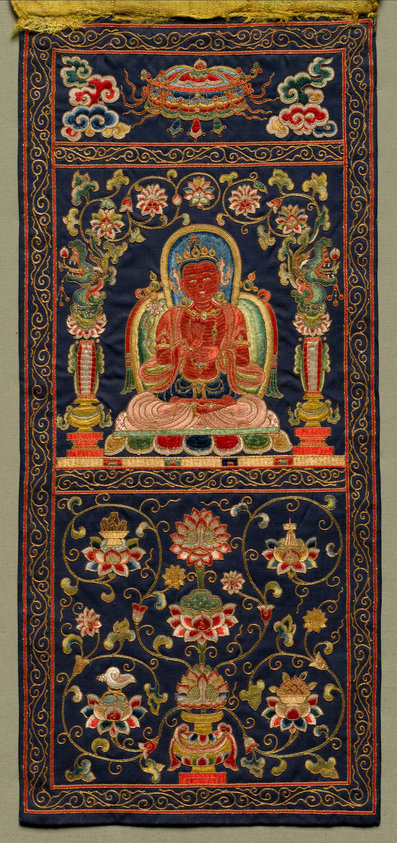
Thangka with the Seventh Bodhisattva
In remarkably pristine condition, this embroidery is from a dispersed set that included images of protectors and bodhisattvas. The embroidery technique and pictorial style are Chinese, but the subject matter and the type of devotional hanging called a thangka are associated with Tibetan Buddhism. Historical records state that during the early Ming dynasty (1368–1644), gifts of Buddhist art were sent from China to Tibet, since relationships between Chinese rulers and Tibetan monastic patriarchs were strong and amicable during this time. A Tibetan inscription on the back notes that this figure is the “seventh bodhisattva,” indicating the position in which it would have hung in a temple hall. Odd-numbered works were hung on one side of the main image, and even-numbered works on the other, counting from the center.
Colors in this work
Details
- Artist
- Unknown artist
- Date
- 1368–1424
- Dimensions
- overall: height 0.438 m, width 0.195 m; mounted: height 0.568 m, width 0.318 m
- Department
- Textiles
- Holding institution
- Cleveland Museum of Art
- Palette
-
Select a color to find related artworks.
- Image provider
- cleveland-museum-of-art
- License
- CC0-1.0
- Credit
- Purchase from the J. H. Wade Fund
Art Genome Taxonomy
12 tags
Subject Matter
-
Deities and Holy Figures Both · 99%
A centrally placed seated sacred figure is visible, and the museum identifies it as the seventh bodhisattva.
-
Flora Visual · 99%
Lotus blossoms, flowering stems, and repeated vegetal motifs appear throughout the central field and lower ornamental section.
Visual Qualities
-
Symmetrical Visual · 99%
The frontal figure is centered on a vertical axis and flanked by closely paired floral arrangements, vessels, and ornamental forms.
-
Highly Ornamented Visual · 99%
Dense gold outlining, elaborate floral and cloud motifs, jeweled costume details, and multiple decorative borders cover much of the dark ground.
-
Patterns Visual · 99%
Repeated cloud scrolls, curling vines, lotus blossoms, floral vessels, and border bands establish a sustained decorative pattern system.
-
Bright and Vivid Colors Visual · 95%
Saturated reds, greens, blues, whites, pinks, and golds create a vivid, high-contrast palette against the deep blue ground.
Time Periods
-
15th Century Art Metadata · 82%
The catalog date is 1368–1424, which includes the years 1400–1424 within the fifteenth century.
Geographic Regions
-
Chinese Art Metadata · 99%
The catalog gives the place of origin as China and describes the embroidery technique and pictorial style as Chinese.
Materials
-
Gold Metadata · 99%
The catalog specifies silk and gold thread as the embroidery materials.
Cultural and Religious Styles
-
Buddhist Art and Architecture Metadata · 99%
The museum describes the work as a thangka with a bodhisattva subject associated with Tibetan Buddhism.
Textiles
-
Embroidery Both · 100%
The museum catalogs the work as embroidery, and the image visibly shows dense stitched ornament and figurative forms on a textile ground.
-
Use of Fabric Both · 98%
The object is a fabric devotional hanging with a visible satin-like ground; the catalog identifies silk satin as the ground material.
Source & rights
Unknown artist. Thangka with the Seventh Bodhisattva. Cleveland Museum of Art.
High-resolution sources
- Original TIFF ↗ 7,529 × 16,000 · Cleveland Museum Of Art · Available