Peonies
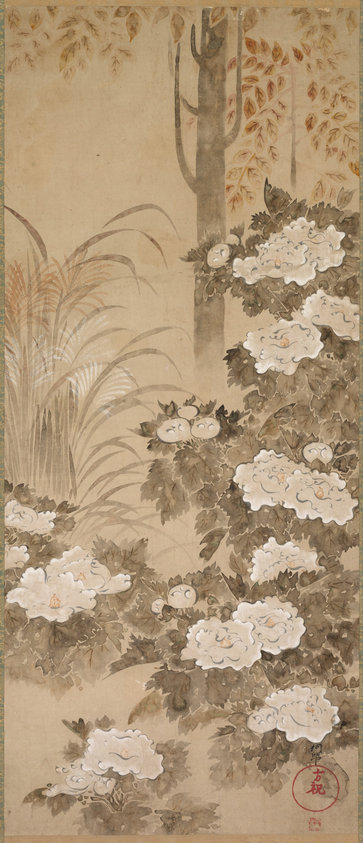
A proliferation of white tree peonies dominates this composition. Behind them are tall, feathery-topped susuki grasses and leafy deciduous trees. Tatebayashi Kagei restricted his palette to ink with red and white color, along with sparing use of green in the peony leaves and the blades of grass. He made generous use of the “dripping-in” (tarashikomi) technique, layering pooled ink and color, in the peony leaves. The areas left in reserve create the impression of insect-eaten or late season foliage.
Colors in this work
Details
- Date
- mid 1700s
- Dimensions
- painting only: height 0.909 m, width 0.362 m
- Department
- Japanese Art
- Holding institution
- Cleveland Museum of Art
- Palette
-
Select a color to find related artworks.
- Image provider
- cleveland-museum-of-art
- License
- CC0-1.0
- Credit
- Worcester R. Warner Collection
Art Genome Taxonomy
10 tags
Subject Matter
-
Flora Both · 99%
The image is dominated by numerous white tree peony blossoms and their foliage, and the museum description identifies the subject as a proliferation of white tree peonies.
Visual Qualities
-
Earth Tones Both · 96%
The composition is dominated by muted brown, gray-green, tan, and ink tones, with white blossoms and small red accents; the museum describes a restricted palette of ink, red, white, and sparing green.
-
Asymmetrical Visual · 95%
The flowering mass and tree are concentrated toward the right side while the grasses and broad paper ground create open space to the left, producing an asymmetrical composition.
-
Dense Composition Visual · 92%
Multiple overlapping blossoms, leaves, grasses, and trunks create tightly layered areas of vegetation, particularly in the lower and right portions of the scroll.
Medium and Techniques
-
Painting Both · 99%
The museum classifies the work as a painting, and the image visibly shows a painted composition on a paper support.
-
Hanging Scroll Metadata · 99%
The medium is explicitly listed as a hanging scroll; the scroll format and side mounting are also visible in the image.
-
East Asian Ink-and-Wash Painting Metadata · 97%
The medium is ink and color on paper, and the visible work uses ink washes with restrained colored passages in an East Asian painting manner.
-
Use of Traditional Techniques Metadata · 99%
The museum explicitly describes generous use of the dripping-in, or tarashikomi, technique, with pooled ink and color layered in the peony leaves.
Time Periods
-
18th Century Art Metadata · 98%
The museum dates the work to the mid-1700s, within the eighteenth century.
Geographic Regions
-
Japanese Art Metadata · 99%
The work is identified as Japanese Art and as originating in Japan during the Edo period.
Source & rights
Tatebayashi Kagei (Japanese, active mid-1700s). Peonies. Cleveland Museum of Art.
High-resolution sources
- Original TIFF ↗ 3,369 × 7,819 · Cleveland Museum Of Art · Available