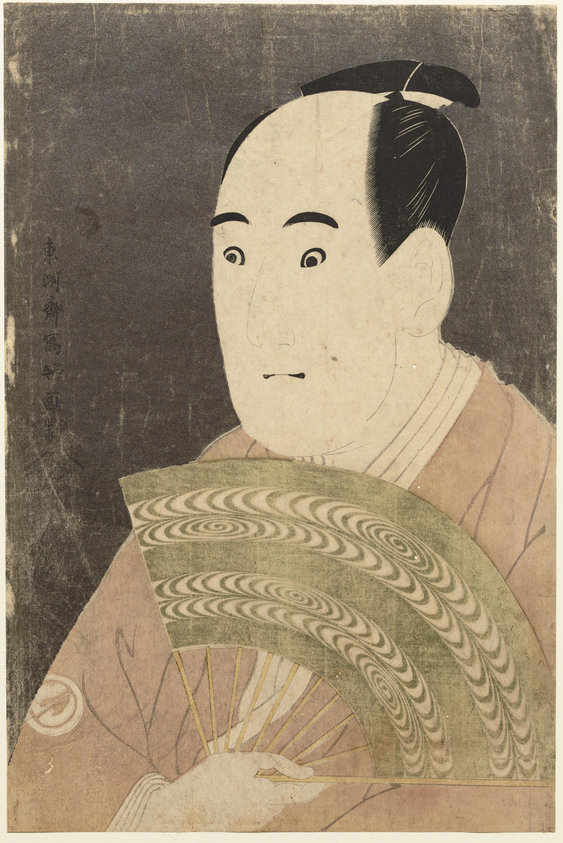
The actor Sawamura Sojuro III as Ogishi Kurando
Part of the series "Portraits of actors at three theaters in Edo". This print depicts the actor Sawamura Sojuro III as Ogishi Kurando. This is a first period print and designated collectively together with 26 other prints from the series as Important Cultural Property of Japan.
Colors in this work
Details
- Artist
- Sharaku
- Date
- 1794
- Holding institution
- Tokyo National Museum
- Palette
-
Select a color to find related artworks.
- Image provider
- wikimedia-commons
- License
- Public domain
- Credit
- Tokyo National Museum
Art Genome Taxonomy
9 tags
Subject Matter
-
Individual Portrait Both · 99%
A single identifiable actor occupies the composition, and the catalog identifies him as Sawamura Sojuro III as Ogishi Kurando.
-
Performing Arts Metadata · 99%
The catalog identifies the work as an actor portrait from the series “Portraits of actors at three theaters in Edo,” placing it within the performing arts.
Visual Qualities
-
Patterns Visual · 99%
Repeating concentric and wave-like motifs cover the large green fan in the foreground.
-
Asymmetrical Visual · 95%
The face and large fan are offset within the sheet, while vertical writing occupies the left margin, producing an uneven, asymmetrical arrangement.
-
Dark Colors Visual · 88%
A dark charcoal ground and black hair contrast with pale flesh tones and subdued salmon and green costume colors.
Medium and Techniques
Time Periods
-
18th Century Art Metadata · 99%
The work is dated 1794, which falls within the eighteenth century.
Geographic Regions
-
Japanese Art Both · 98%
The Edo setting, Japanese script, Japanese subject naming, and catalog context establish the work as Japanese art.
Source & rights
Sharaku. [1]
High-resolution sources
- Original image ↗ 5,117 × 7,669 · Wikimedia Commons · Availability not yet probed