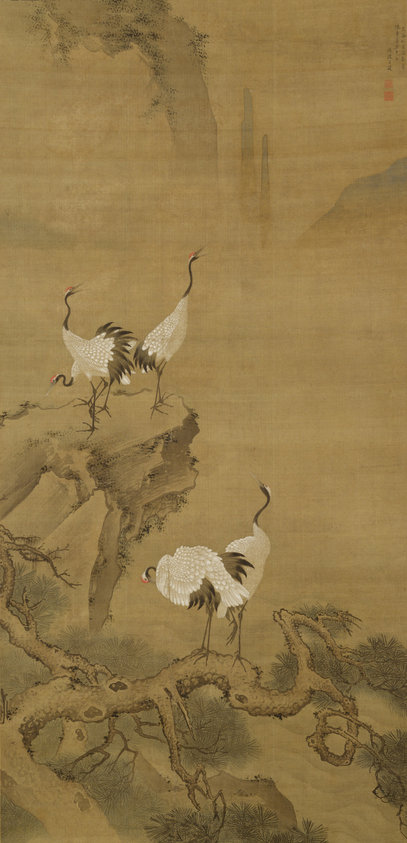
昆侖松鶴
這幅作品被命名為《昆侖松鶴》。昆侖是指神仙們居住的神山——昆侖山。據推測位於中國西部,是中國的大河——黃河的源頭。松和鶴都是長壽的象徵,是和神仙故事頗有關聯的題材。畫面右上方有畫家的署名,並寫著送給一位叫做李懷素的人。以昆侖山上的松樹以及聚集在此的仙鶴為繪畫題材的這幅作品主題極為吉祥,作為賀壽之禮極為相稱。 作者呂健是活躍於十六世紀到十七世紀的人物。其曾祖父呂紀是一位著名的宮廷畫家。呂紀有很多構圖周密的大型花鳥圖作品,其華麗的色彩和細膩的筆法不僅在中國,也在朝鮮半島和日本大受追捧,呂紀的繪畫風格在東亞地區到了廣泛傳播。 呂健不僅認真學習呂紀的花鳥畫,似乎還將其轉化成了更加瀟灑而又惹人憐愛的表現。這幅作品中姿態優美地彎曲著長頸的仙鶴以及以淡綠色輕輕暈開的松葉都充分表現出了呂健的審美觀。淡淡的墨影巧妙地表現出水面上湧起的波浪,以極具透明感的白色顏料細緻描繪的羽毛線條等卓越的描寫技術也是看點所在。
Colors in this work
Details
- Artist
- Lu Jian
- Date
- c. 16th–17th century
- Holding institution
- Tokyo National Museum
- Palette
-
Select a color to find related artworks.
- Image provider
- wikimedia-commons
- License
- Public domain
- Credit
- Tokyo National Museum
Art Genome Taxonomy
11 tags
Subject Matter
-
Animals Both · 99%
Five cranes are clearly visible in the composition, and the catalog identifies them as immortal cranes.
-
Landscapes Both · 98%
Pine trees, rocky ledges, distant mountain forms, and atmospheric space create a mountain landscape; the catalog identifies the setting as Kunlun Mountain.
-
Mythology and Religion Metadata · 90%
The catalog describes Kunlun as a sacred or mythic mountain associated with immortals and connects the subject to immortal stories.
-
Symbolic Composition Metadata · 93%
The catalog explicitly describes pine and cranes as symbols of longevity and presents their combination as an auspicious subject.
-
Text Visual · 99%
A vertical inscription and red seals are visibly present near the upper-right edge of the painting.
Visual Qualities
-
Earth Tones Visual · 98%
The image is dominated by muted ochre and brown tones, with subdued green, gray, black, and white accents.
-
Highly Detailed Both · 98%
Fine repeated marks articulate crane feathers, pine needles, and rock textures; the catalog also emphasizes the finely painted feather lines and softly washed pine needles.
Medium and Techniques
-
Painting Visual · 99%
The image visibly presents a representational painting with brush-rendered birds, trees, rocks, and atmospheric landscape elements.
Time Periods
-
16th Century Art Metadata · 94%
The work is dated by the catalog to approximately the 16th–17th century, spanning both centuries.
-
17th Century Art Metadata · 90%
The catalog gives the date as approximately the 16th–17th century.
Geographic Regions
-
Chinese Art Metadata · 99%
The Tokyo National Museum catalog identifies the work as a Chinese painting by Lu Jian (呂健).
Source & rights
呂健. https://openmuseum.tw/muse/digi_object/88549c827f7808f376856948dd5f086c
High-resolution sources
- Original image ↗ 1,449 × 3,000 · Wikimedia Commons · Availability not yet probed