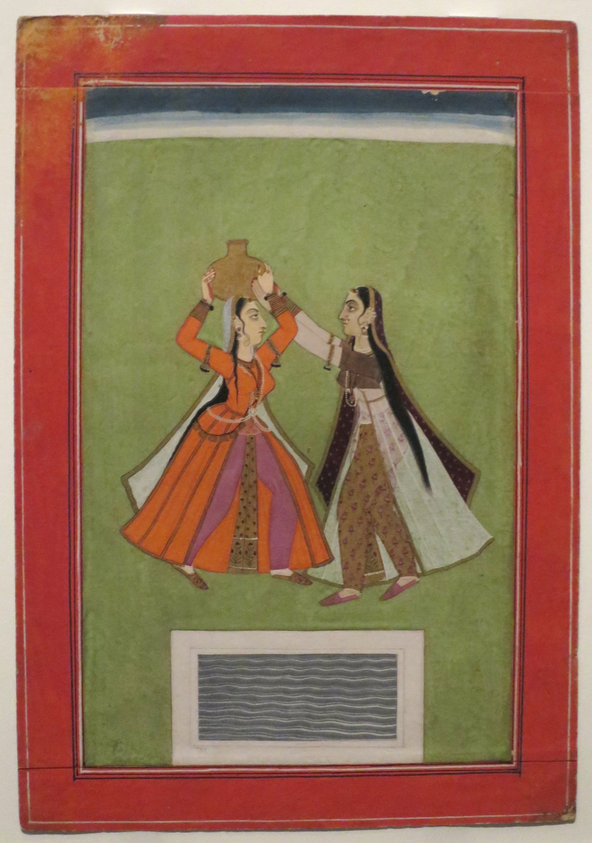
Heer Ranjha: Lady with Water Jug on her Head and Lady Holding out her Arms
Heer Ranjha: Lady with Water Jug on her Head and Lady Holding out her Arms, Jodhpur school, India, c. mid-18th century, opaque watercolor on paper, Tokyo National Museum
Colors in this work
Details
- Artist
- Unknown artist
- Date
- c. mid-18th century
- Holding institution
- Tokyo National Museum
- Palette
-
Select a color to find related artworks.
- Image provider
- wikimedia-commons
- License
- Public domain
- Credit
- Tokyo National Museum
Art Genome Taxonomy
11 tags
Subject Matter
-
Human Figure Visual · 99%
Two clearly rendered human figures occupy the central composition, with visible faces, hands, bodies, and garments.
-
Narrative Both · 82%
The title places the scene within the Heer Ranjha narrative, while the figures’ coordinated gestures and interaction with the jug create an implied episode.
-
Water Both · 82%
The title identifies a water jug, and the lower rectangular panel visibly contains repeated horizontal wave-like lines that appear to represent water.
Visual Qualities
-
Bright and Vivid Colors Visual · 96%
The composition uses highly saturated orange, red, purple, green, white, and dark blue-gray passages, especially in the figures’ clothing and surrounding border.
-
Contour Line Visual · 94%
The figures and their garments are defined by firm, clearly visible outlines.
-
Patterns Visual · 90%
Repeated ornamental motifs are visible across the garments, particularly the patterned skirt and dark veil of the right-hand figure.
-
Flatness Visual · 93%
The figures stand against a largely unmodulated green field with limited recession, producing a deliberately shallow and planar appearance.
Medium and Techniques
-
Watercolor Both · 99%
The metadata identifies the work as an opaque watercolor, while the image shows matte, opaque-looking areas of water-based paint applied in relatively flat color fields.
-
Work on Paper Metadata · 99%
The catalog description explicitly identifies the support as paper.
Time Periods
-
18th Century Art Metadata · 97%
The catalog dates the work to approximately the mid-18th century.
Geographic Regions
-
Indian Art Metadata · 98%
The catalog identifies the work as belonging to the Jodhpur school in India.
Source & rights
Unknown authorUnknown author. Tokyo National Museum
High-resolution sources
- Original image ↗ 2,330 × 3,320 · Wikimedia Commons · Availability not yet probed