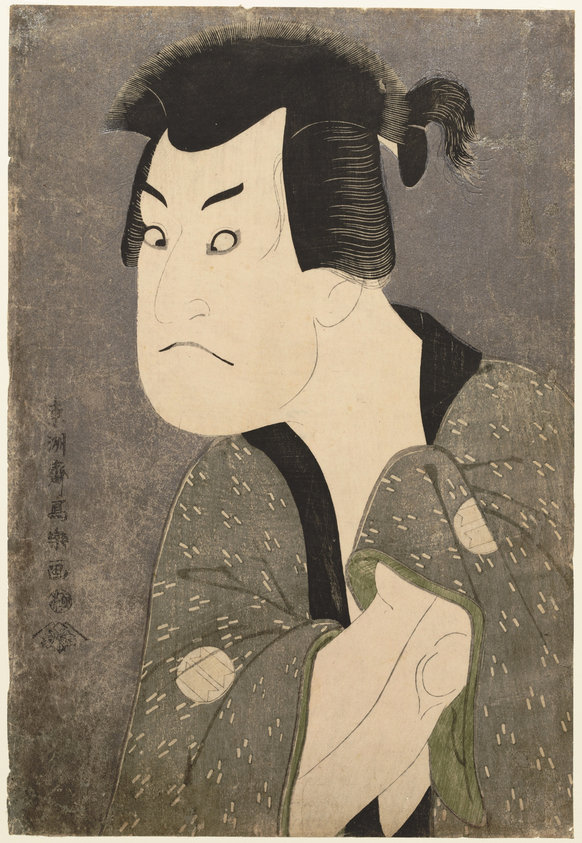
The actor Sakata Hangoro III as the villain Fujikawa Mizuemon
Part of the series "Portraits of actors at three theaters in Edo". This print depicts the actor Sakata Hangoro III as the villain Fujikawa Mizuemon. This is a first period print and designated collectively together with 26 other prints from the series as Important Cultural Property of Japan.
Colors in this work
Details
- Artist
- Sharaku
- Date
- 1794
- Holding institution
- Tokyo National Museum
- Palette
-
Select a color to find related artworks.
- Image provider
- wikimedia-commons
- License
- Public domain
- Credit
- Tokyo National Museum
Art Genome Taxonomy
10 tags
Subject Matter
-
Individual Portrait Both · 99%
The title and catalog description identify Sakata Hangoro III as the depicted actor, while the image presents one clearly individualized figure in a close portrait format.
-
Performing Arts Both · 99%
The metadata identifies the subject as an actor and places the work in a series of actor portraits; the stylized expression, costume, and pose are visibly theatrical.
-
Face Visual · 99%
The face is the central visual focus, with enlarged eyes, strongly articulated brows, a compressed mouth, and simplified contour lines.
Styles and Movements
-
Ukiyo-e Interpretive · 90%
The Edo-period actor portrait, print format, and representation of a kabuki performer strongly support an ukiyo-e classification, although the supplied metadata does not explicitly name the movement.
Visual Qualities
-
Patterns Visual · 99%
Small repeated pale dash-like marks cover the muted gray-green robe, while circular motifs appear on the garment and sleeve.
-
Flatness Visual · 95%
The image relies on broad, relatively flat areas of muted color bounded by economical contour lines, with little modeled shading.
-
Contour Line Visual · 94%
The figure, robe, hair, and inscription are defined by emphatic linear contours, especially around the face, hairstyle, sleeves, and hand.
Medium and Techniques
-
Prints Metadata · 98%
The work is explicitly described as a print in the catalog, and the image has the flat color fields, contour drawing, and inked inscription associated with a Japanese print.
Time Periods
-
18th Century Art Metadata · 100%
The work is dated 1794, placing it in the eighteenth century.
Geographic Regions
-
Japanese Art Metadata · 97%
The catalog identifies the classification as Japanese painting or print and locates the series in Edo; the named artist Sharaku is associated with Japanese art.
Source & rights
Sharaku. [1]
High-resolution sources
- Original image ↗ 5,089 × 7,375 · Wikimedia Commons · Availability not yet probed