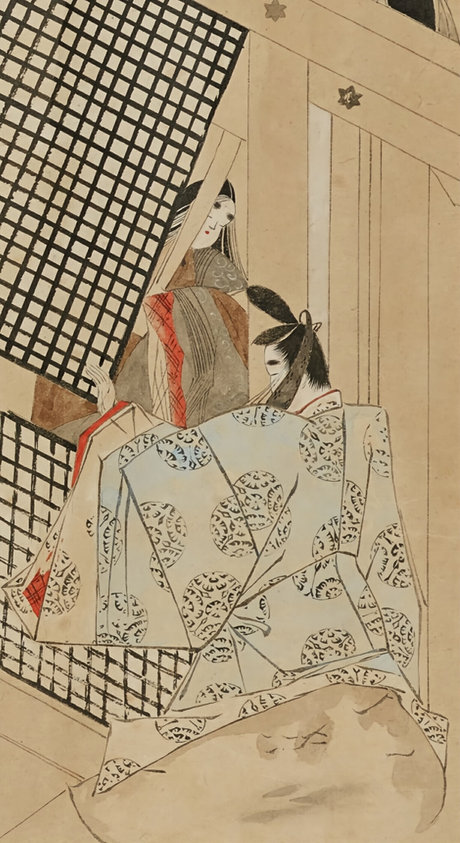
中宮亮実成
暮れて月いとおもしろきに、宮の亮、女房にあひて、とりわきたるよろこびも啓せさせむとにやあらむ、妻戸のわたりも御湯殿のけはひに濡れ、人の音もせざりければ、この渡殿の東のつまなる宮の内侍の局に立ち寄りて、「ここにや」と案内したまふ。宰相は中の間に寄りて、まだ鎖さぬ格子の上押し上げて、「おはすや」などあれど、いらへもせぬに、な大夫の、「ここにや」とのたまふにさへ、聞きしのばむもことごとしきやうなれば、はかなきいらへなどす。いと思ふことなげなる御けしきどもなり。
Colors in this work
Details
- Artist
- Iseri Ichiji (copyist)
- Date
- 1919
- Holding institution
- Tokyo National Museum
- Palette
-
Select a color to find related artworks.
- Image provider
- wikimedia-commons
- License
- Public domain
- Credit
- Tokyo National Museum
Art Genome Taxonomy
11 tags
Subject Matter
-
Human Figure Visual · 99%
Two human figures in layered garments occupy the architectural setting, with one figure in the foreground and another behind the lattice screen.
-
Interiors Visual · 98%
Sliding panels, beams, lattice screens, and other architectural elements establish an enclosed or semi-enclosed interior setting.
-
Narrative Both · 93%
The image depicts a specific encounter between figures, while the supplied Japanese description narrates figures approaching a chamber and calling out to its occupant.
Visual Qualities
-
Patterns Visual · 99%
Repeated floral and medallion-like motifs cover the robes, and the lattice and panel divisions create additional repeated structures.
-
Geometric Visual · 98%
The dominant lattice screen and architectural panel divisions form a pronounced system of repeated rectangular geometry.
-
Linear Forms Visual · 97%
Dark contour lines define the figures, garments, latticework, and architectural framing throughout the image.
-
Asymmetrical Visual · 93%
The large diagonal screen and foreground robe create an uneven distribution of visual weight across the vertical composition.
-
Earth Tones Visual · 98%
Beige, brown, gray, black, and muted red dominate the visible palette.
-
Highly Detailed Visual · 94%
The layered robes, repeated textile motifs, latticework, fittings, and small facial details are rendered with sustained descriptive detail.
Time Periods
-
1918 - 1939 (Interwar) Art Metadata · 100%
The canonical date is 1919, which falls within the catalog’s 1918–1939 interwar art period.
Geographic Regions
-
Japanese Art Both · 99%
Canonical metadata identifies the object as a Japanese painting or print, and the image visibly uses Japanese courtly dress, architectural screens, latticework, and stylized figuration.
Source & rights
井芹一二模. 東京国立博物館
High-resolution sources
- Original image ↗ 1,535 × 2,813 · Wikimedia Commons · Availability not yet probed