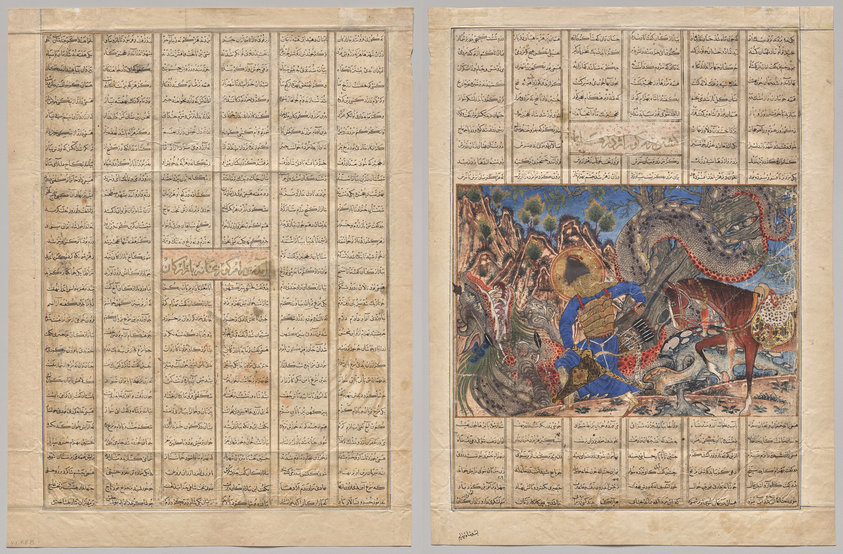
Bahram Gur Arrives at the House of a Merchant, text page (recto); Bahram Gur Slays a Dragon (verso), from a Shahnama (Book of Kings) of Firdausi (940–1019 or 1025), known as the Great Mongol Shahnama
In this intense painting, Bahram Gur plunges his sword into the breast of a dragon. A favorite character from Iran's pre-Islamic history, Bahram Gur (reigned 420–38 CE) was a popular ruler of the Sasanian dynasty and a great hunter. He took the name "Gur," meaning onager (a wild ass), because it was his preferred game, although he also excelled at killing dragons. As evidenced by this illustration's rock formations, tree trunk, and dragon, Iranian painting in the Mongol period borrowed numerous stylistic and spatial elements from Chinese models. With the surging landscape and writhing drago...
Details
- Palette
-
Select a color to find related artworks.
- Dimensions
- sheet: height 0.458 m, width 0.344 m
- Department
- Islamic Art
- Holding institution
- Cleveland Museum of Art
- Image provider
- cleveland-museum-of-art
- License
- CC0-1.0
- Credit
- Grace Rainey Rogers Fund
Art Genome Taxonomy
12 tags
Subject Matter
-
Narrative Both · 99%
The museum identifies the image as a Shahnama episode depicting Bahram Gur slaying a dragon, while the image visibly presents a concentrated action scene within a manuscript page.
-
Hybrids and Imaginary Creatures Both · 99%
A large fantastical, serpentine dragon with a coiling body dominates the painted scene.
-
Human Figure Both · 99%
A human figure is clearly shown bending forward and wielding a sword; the catalog identifies him as Bahram Gur.
-
Equestrian Both · 97%
The scene includes a decorated horse closely associated with the armed protagonist, and the catalog describes Bahram Gur as a celebrated hunter.
-
Landscapes Both · 98%
The painted scene contains jagged rock formations, trees, foliage, and open ground; the catalog specifically describes its surging landscape.
-
Engaged with Traditional Chinese Art Both · 94%
The catalog explicitly states that the rock formations, tree trunk, and dragon reflect the borrowing of stylistic and spatial elements from Chinese pictorial models.
Visual Qualities
-
Patterns Visual · 98%
Repeated ornamental motifs are visible across the dragon, horse trappings, clothing, rocks, foliage, and page structure.
Medium and Techniques
-
Watercolor Metadata · 99%
The recorded medium is opaque watercolor, ink, and gold on paper.
-
Manuscript Both · 99%
The museum classifies the object as a manuscript, and the image visibly shows ruled columns of handwritten text surrounding a painted illustration.
Time Periods
-
1000 - 1400 CE Art Metadata · 99%
The catalog dates the leaf to 1330–35, within the 1000–1400 CE period.
Geographic Regions
-
Iranian Art Metadata · 99%
The recorded place of origin is Iran, specifically Tabriz, during the Ilkhanid period.
Cultural and Religious Styles
-
Islamic Art and Architecture Metadata · 99%
The museum records the work under Islamic Art and lists Islamic Art among its classifications.
Source & rights
Unknown artist. Bahram Gur Arrives at the House of a Merchant, text page (recto); Bahram Gur Slays a Dragon (verso), from a Shahnama (Book of Kings) of Firdausi (940–1019 or 1025), known as the Great Mongol Shahnama. Cleveland Museum of Art.