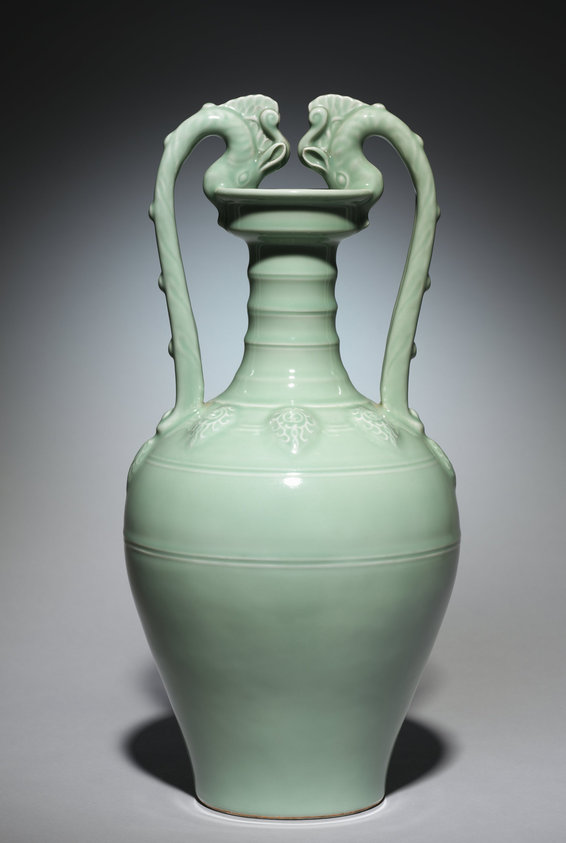
Amphora Vase
This elegant vase, modeled in the shape of an amphora with dragon handles has perfect symmetry. Its celadon glaze is of exceptional purity and of subtle green color, all characteristics of classical Yongzheng-era monochrome porcelains. The amphora shape and dragon handles of this vase, seen earlier in the glazed stoneware of the Sui and Tang dynasties (581-907), were revived during the Yongzheng period for achieving "antique-elegance" (guya) in aesthetics as well as technical perfection in ceramic art.Only four vases of this size and glaze are known to exist.
Details
- Palette
-
Select a color to find related artworks.
- Medium
- porcelain with celadon glaze
- Dimensions
- overall: height 0.521 m
- Origin
- China, Jiangxi Province, Jingdezhen, Qing dynasty (1644–1911), Yongzheng mark and period (1723–35)
- Department
- Chinese Art
- Holding institution
- Cleveland Museum of Art
- Image provider
- cleveland-museum-of-art
- License
- CC0-1.0
- Credit
- The Elisabeth Severance Prentiss Collection
Art Genome Taxonomy
7 tags
Visual Qualities
-
Smooth Surface Both · 98%
The vessel has an even, highly polished-looking glazed surface, and the catalog emphasizes the purity and subtlety of its celadon glaze.
-
Symmetrical Both · 99%
The frontal view shows strong bilateral symmetry in the body, neck, ornament, and paired handles; the catalog explicitly describes the vase as perfectly symmetrical.
Time Periods
-
18th Century Art Metadata · 99%
The museum dates the object to 1723–35, within the eighteenth century.
Geographic Regions
-
Chinese Art Metadata · 99%
The catalog identifies the place of origin as Jingdezhen in Jiangxi Province, China, and classifies the work under Chinese Art.
Materials
Tableware, Vessels, and Objects
-
Vase Both · 99%
The image clearly shows a handled vase, and the museum title identifies the object as Amphora Vase.
Source & rights
Unknown artist. Amphora Vase. Cleveland Museum of Art.