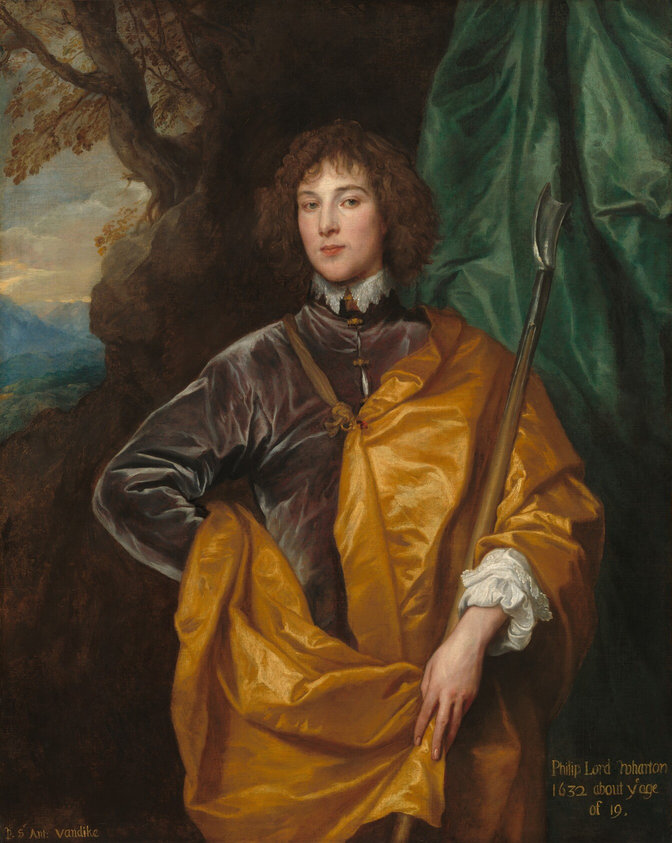
Philip, Lord Wharton
Shown from about the hips up, a young, pale-skinned man with curly brown hair stands facing and looking at us, wearing a plum-purple coat under a golden yellow cape in this vertical portrait painting. The man’s oval face is angled a little to our left so he looks out from the corners of his gray eyes. His left eyebrow, on our right, is slightly arched. His skin is smooth and his cheeks lightly flushed. He has a long, straight nose, his pink lips are closed, and there is a faintly painted suggestion of a goatee. Wavy bangs fall across his forehead, and he has curly, chin-length hair. He stands with his right hand, on our left, on his hip, and in his other arm, he holds a wooden staff with a pewter-gray, metal, scoop-like hook at the top. White lace trims the high neck of his garment and the cuffs of his sleeves. Light reflecting off the plum-purple coat suggests a soft material, possibly velvet. Crisp reflections on the deep, butter-yellow cape fastened over one shoulder suggest satin. An emerald-green cloth hanging from the top right corner of the painting falls behind the man’s shoulder. Behind the cloth and to our left, a craggy, rocky outcropping opens to a view of a landscape with a green valley and topaz-blue mountains in the distance. Bands of golden light illuminate the cloudy sky above. The work is inscribed with yellow lettering in the lower right corner to read, “Philip Lord Wharton 1632 about ye age of 19.” The artist’s name is painted in the lower left: “P. Sr Ant: vandike.”
Details
- Palette
-
Select a color to find related artworks.
- Medium
- oil on canvas
- Dimensions
- overall: 133 x 106 cm (52 3/8 x 41 3/4 in.) framed: 171.8 x 144.1 cm (67 5/8 x 56 3/4 in.)
- Department
- CNE-B
- Holding institution
- National Gallery of Art
- Image provider
- national-gallery-of-art
- License
- CC0-1.0
- Credit
- Andrew W. Mellon Collection
Art Genome Taxonomy
8 tags
Subject Matter
-
Individual Portrait Both · 99%
The title and catalog identify the sitter as Philip, Lord Wharton, while the image clearly shows one individualized sitter in a formal portrait composition.
-
Face Visual · 98%
The sitter’s face is prominently modeled and directed toward the viewer, making facial presence a major focus of the composition.
-
Landscapes Visual · 91%
A visible opening at the left reveals a green valley, distant blue mountains, rocky terrain, and sky behind the sitter.
Visual Qualities
-
Dark Colors Visual · 95%
Dark browns, blacks, and deep greens dominate much of the composition, especially in the tree, background, and drapery.
-
Bright and Vivid Colors Visual · 88%
The saturated golden-yellow cape and green drapery create strong, vivid color accents against the dark surroundings.
-
Shiny/Glossy Both · 86%
Strong painted highlights on the purple garment and golden cape produce a glossy textile effect; the catalog describes these effects as suggesting velvet and satin rather than establishing the actual fabrics.
Medium and Techniques
-
Oil Painting Both · 99%
The image is visibly an oil painting, and the catalog specifies the medium as oil on canvas.
Time Periods
-
17th Century Art Metadata · 99%
The catalog dates the work to 1632, placing it in the seventeenth century.
Source & rights
Sir Anthony van Dyck. Philip, Lord Wharton. Courtesy National Gallery of Art, Washington.