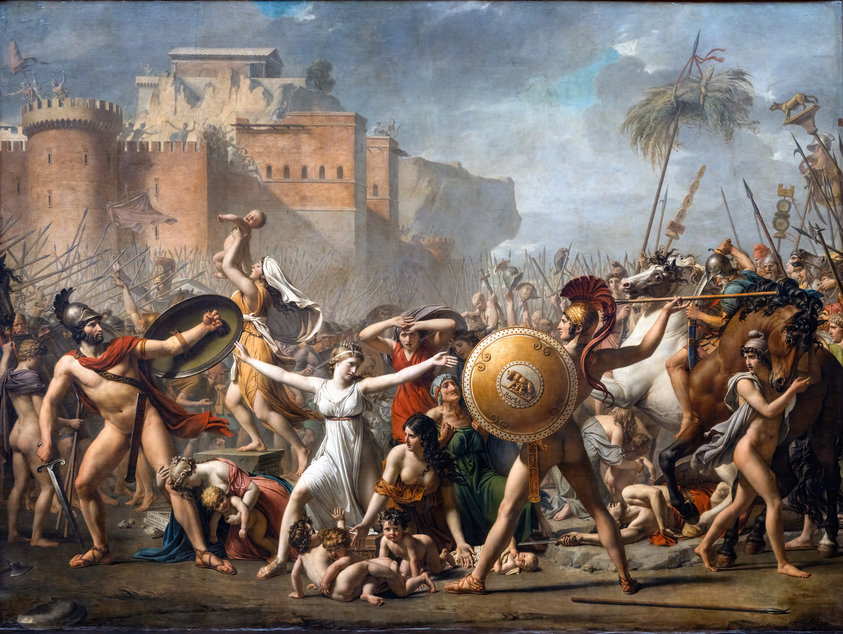
Les Sabines
"Le moment est celui où le combat entre les Romains et les Sabins est interrompu par la présence des Sabines. L'enlèvement des Sabines par les Romains ayant donné lieu à une guerre contre les ravisseurs, de la part des Sabins et des autres peuples offensés, Romulus, roi de Rome, les défit tous. Cependant Tatius, roi de Cures, prit les armes avec plus de succès, et s'empara de la citadelle de Rome. Le lendemain l'armée des Romains ayant livré bataille, fut mise en déroute ; mais Romulus, après avoir imploré le secours de Jupiter Stator, rallia les troupes, et mit en fuite, avec son armée, Ta...
Details
- Palette
-
Select a color to find related artworks.
- Medium
- huile sur toile
- Dimensions
- Hauteur 3,85 m; Largeur 5,22 m; Hauteur avec accessoire 4,434 m; Largeur avec accessoire 5,8 m
- Department
- Département des Peintures
- Holding institution
- Musée du Louvre
- Image provider
- wikimedia-commons
- License
- Public domain
- Credit
- Musée du Louvre, Département des Peintures
Art Genome Taxonomy
12 tags
Subject Matter
-
Conflict Both · 99%
Armed Roman and Sabine forces confront one another across the scene, while the Louvre description explicitly identifies the interrupted battle between the two groups.
-
War and Military Both · 99%
Spears, swords, shields, armor, military standards, soldiers, and horses dominate the composition; the catalog identifies the opposing armies and their commanders.
-
Narrative Both · 99%
The painting stages a specific legendary event with multiple identifiable actions, and the catalog supplies the episode's detailed narrative involving Romulus, Tatius, Hersilie, and the Sabine women.
-
Antiquity as Subject Both · 99%
The setting, costumes, armor, standards, and Roman imagery evoke antiquity, while the catalog identifies the scene as the Roman-Sabine episode at Rome.
-
Family Both · 95%
Women and children are prominently placed between the combatants, and the catalog describes wives, mothers, grandmothers, and children intervening to protect their families.
-
Human Figure Visual · 99%
The composition is dominated by numerous full-length and partial human figures, including soldiers, women, children, and fallen bodies.
Styles and Movements
-
Neoclassicism Interpretive · 96%
The 1799 painting combines an ancient Roman subject, idealized anatomy, sharply articulated contours, classical costume, and monumental historical composition, all strongly characteristic of Neoclassicism.
Visual Qualities
-
Dense Composition Visual · 99%
Figures, weapons, horses, standards, architectural forms, and fallen bodies occupy nearly the entire foreground and middle ground.
-
Highly Detailed Visual · 95%
Armor, shields, weapons, drapery, hair, horses, architectural surfaces, and individual gestures are rendered with extensive descriptive detail.
Medium and Techniques
-
History Painting Visual · 97%
The monumental canvas presents a staged, multi-figure historical or legendary episode with military action, civic architecture, and theatrical gestures.
-
Large-Scale Painting Both · 99%
The image presents a monumental canvas, and the catalog records dimensions of approximately 3.85 by 5.22 meters.
-
Oil Painting Metadata · 100%
The Louvre catalog specifies the medium as huile sur toile, or oil on canvas.
Source & rights
Jacques-Louis David. Own work