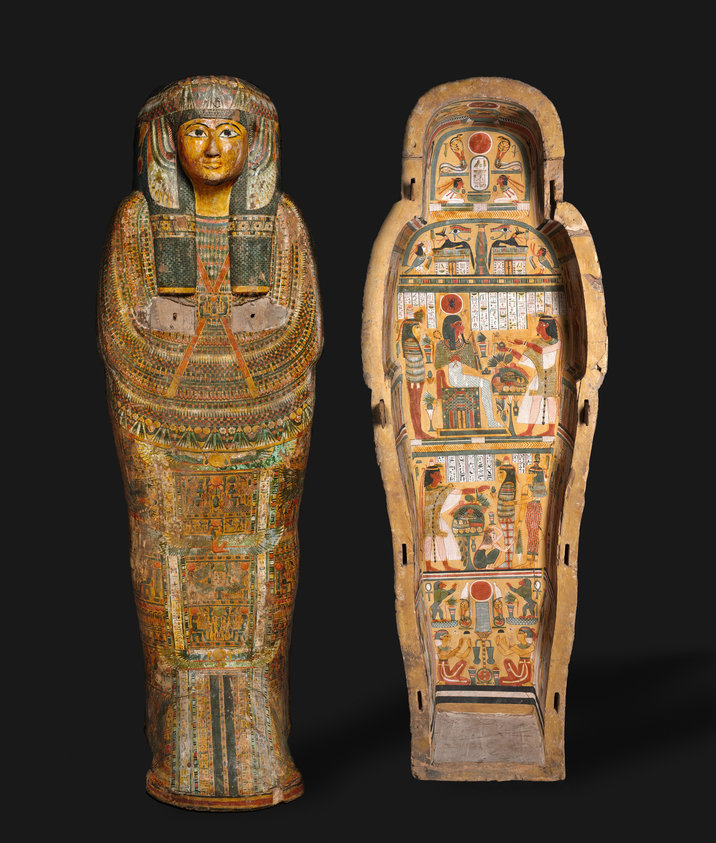
Coffin of Nesykhonsu
Egyptian coffins told stories and illustrated spells to help the deceased transition safely to the afterlife. Inside Nesykhonsu's coffin there are two jackals, one facing right and the other left, near the top. Here, the jackal represents the powerful deity Anubis, the god of the afterlife and embalming.
Details
- Palette
-
Select a color to find related artworks.
- Dimensions
- overall: width 0.7 m
- Department
- Egyptian and Ancient Near Eastern Art
- Holding institution
- Cleveland Museum of Art
- Image provider
- cleveland-museum-of-art
- License
- CC0-1.0
- Credit
- Gift of the John Huntington Art and Polytechnic Trust
Art Genome Taxonomy
12 tags
Subject Matter
-
The Afterlife Metadata · 98%
The museum describes Egyptian coffins as helping the deceased transition safely to the afterlife.
-
Deities and Holy Figures Both · 97%
The interior includes religious figures and two jackals identified by the museum as representations of Anubis, a deity associated with the afterlife and embalming.
-
Mythology and Religion Both · 97%
Painted religious scenes, hieroglyphic text, and funerary imagery cover the coffin’s interior and exterior; the museum explicitly discusses its connection to Egyptian funerary belief.
-
Animals Both · 96%
Two jackal representations are clearly visible near the upper interior, and the museum identifies them as Anubis imagery.
-
Text Both · 96%
Columns of hieroglyphic inscriptions are visibly arranged across the interior and exterior, and the museum describes coffins as bearing stories and spells.
Visual Qualities
-
Highly Ornamented Visual · 99%
The coffin is densely covered with painted registers, borders, figures, hieroglyphs, repeated motifs, and ornamental bands.
-
Symmetrical Visual · 93%
The exterior is organized around a strong vertical axis, and the interior uses balanced horizontal registers with paired or mirrored elements.
Time Periods
-
Ancient Art Metadata · 99%
The catalog dates the coffin to approximately 976–889 BCE, placing it within ancient art.
Geographic Regions
-
Egyptian Art Metadata · 99%
The place of origin is recorded as Egypt, Thebes, in the Third Intermediate Period.
Materials
-
Wood Metadata · 99%
The recorded medium is gessoed and painted sycamore fig, a wood substrate.
Cultural and Religious Styles
-
Ancient Egypt Both · 99%
The catalog identifies the object as Egyptian, and its human-shaped coffin form, hieroglyphic inscriptions, and funerary imagery are visible in the image.
Antiquities, Artifacts, and Religious Objects
-
Funerary/Commemorative Object Metadata · 99%
The museum classifies the object as funerary equipment and identifies it as the Coffin of Nesykhonsu.
Source & rights
Unknown artist. Coffin of Nesykhonsu. Cleveland Museum of Art.