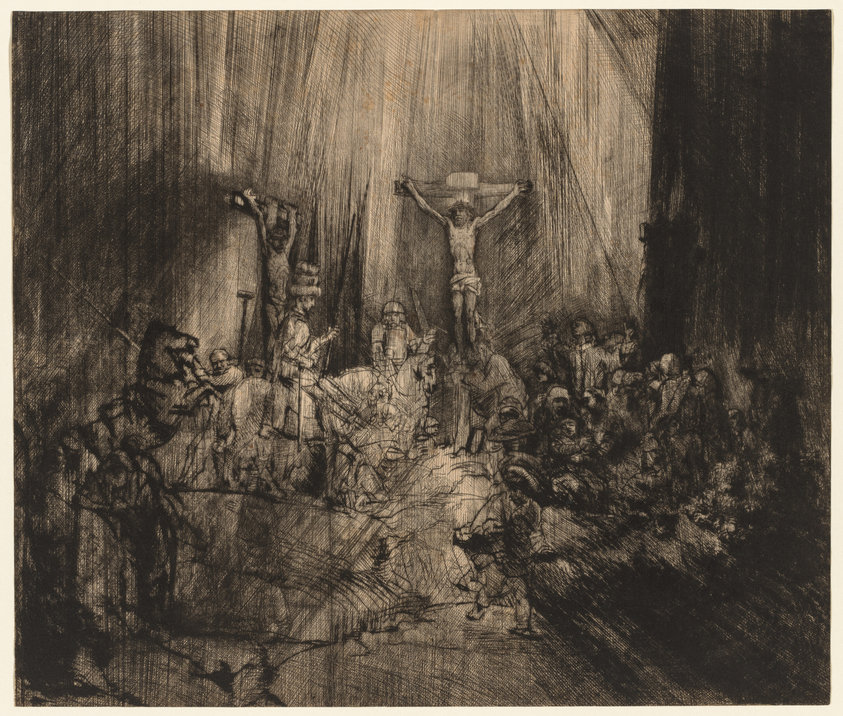
Christ Crucified Between the Two Thieves: 'The Three Crosses'
Rembrandt’s Christ Crucified Between the Two Thieves is executed entirely in drypoint. Because of the delicacy of the technique, the copper plate was worn after the artist printed about 40 impressions of the first three states. In order to continue using the plate, Rembrandt reworked it, changing the image somewhat. In this fourth state, slashing strokes obscure the spectators visible in the earlier version, creating a tenebrous setting that focuses attention on Christ bathed in celestial light. Although drypoint is an inherently linear medium, Rembrandt used it to obtain tonal qualities as...
Details
- Palette
-
Select a color to find related artworks.
- Medium
- drypoint
- Dimensions
- sheet: height 0.375 m, width 0.44 m
- Origin
- Rembrandt, 17th century
- Department
- Prints
- Holding institution
- Cleveland Museum of Art
- Image provider
- cleveland-museum-of-art
- License
- CC0-1.0
- Credit
- Bequest of Ralph King and Purchase from the J. H. Wade Fund
Art Genome Taxonomy
11 tags
Subject Matter
-
Bible Story Both · 99%
The title identifies the Crucifixion between two thieves, and the image visibly presents three crosses with Christ at the center.
-
Deities and Holy Figures Both · 96%
Christ is identified by the title and appears as the central sacred figure on the most prominently illuminated cross.
-
Crowds Visual · 95%
A large, densely gathered group of spectators, attendants, and apparent soldiers occupies the middle and lower portions of the composition.
Visual Qualities
-
Dark Colors Both · 99%
The image is dominated by deep black and brown-black passages, while the museum describes the reworked state as tenebrous and focused on Christ’s light.
-
Dense Composition Both · 98%
Overlapping figures, extensive crosshatching, and concentrated marks fill much of the sheet; the catalog also emphasizes the dense slashing strokes of the fourth state.
-
Linear Forms Visual · 96%
Directional drypoint lines, crosshatching, and vigorous strokes construct the figures, crowd, ground, and surrounding atmosphere.
Medium and Techniques
-
Prints Metadata · 100%
The Cleveland Museum of Art classifies the work as a print and places it in the Prints department.
-
Intaglio Metadata · 99%
The museum identifies the medium as drypoint, an intaglio printmaking technique.
-
Chiaroscuro Both · 96%
A sharply illuminated central figure and cross emerge from surrounding darkness, corresponding to the museum’s description of the opposition between blackness and celestial light.
Time Periods
-
17th Century Art Metadata · 99%
The work is dated 1653–c. 1660 and is identified as a seventeenth-century work by Rembrandt.
Geographic Regions
-
Dutch Art Metadata · 99%
The artist is identified as Rembrandt van Rijn (Dutch, 1606–1669).
Source & rights
Rembrandt van Rijn (Dutch, 1606–1669). Christ Crucified Between the Two Thieves: 'The Three Crosses'. Cleveland Museum of Art.