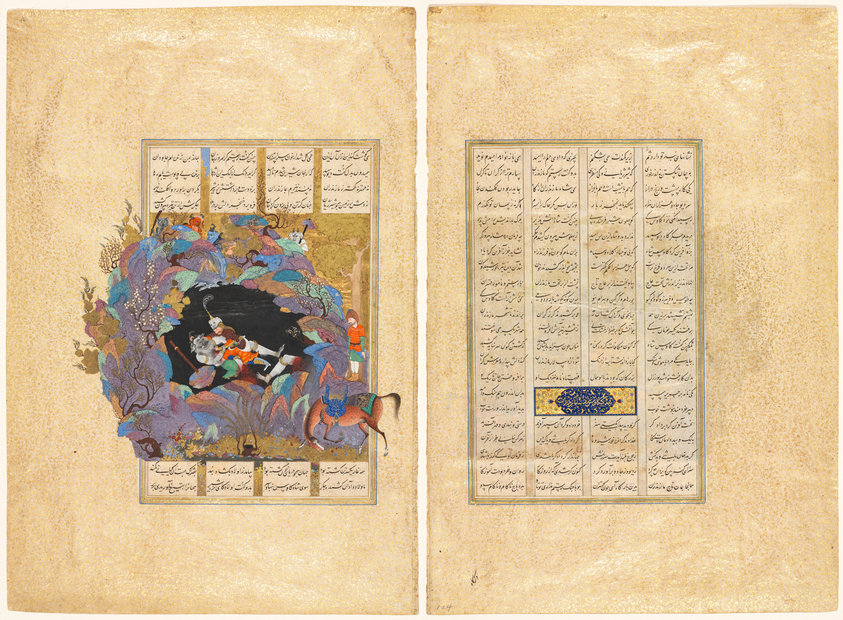
Rustam's seventh course: He kills the White Div, folio 124 from a Shah-nama (Book of Kings) of Firdausi (Persian, about 934–1020)
Mir Musavvir (attributed) Abd al-Vahhab (attributed)
The legendary hero Rustam brutally takes the demon chief’s liver blood, needed to cure his king of blindness. Paintings from the Shah-nama made for the Persian ruler Shah Tahmasp (reigned 1524–76) were acclaimed in their day for their brilliant coloring and refinement. Seven of the artists who contributed to this book moved to India to lead the new Mughal painting workshop in the 1550s. They introduced to the Indian artists a more complex color sensibility and preference for presenting faces in three-quarter view, as opposed to in profile.
Details
- Palette
-
Select a color to find related artworks.
- Dimensions
- sheet: height 0.475 m, width 0.322 m; image: height 0.284 m, width 0.185 m
- Department
- Islamic Art
- Holding institution
- Cleveland Museum of Art
- Image provider
- cleveland-museum-of-art
- License
- CC0-1.0
- Credit
- Leonard C. Hanna Jr. Fund
Art Genome Taxonomy
11 tags
Subject Matter
-
Narrative Both · 99%
The title identifies a specific episode from Firdausi’s Shah-nama, while the miniature visibly stages an action involving several figures, a demon-like body, and a horse.
-
Conflict Both · 99%
The catalog identifies Rustam killing the White Div, and the image centers on a violent physical struggle between the principal figures.
-
Human Figure Visual · 99%
Multiple human figures are clearly rendered within the miniature, including the central combatants and a standing figure at the right.
-
Animals Visual · 99%
A decorated horse is clearly depicted in the lower foreground of the miniature.
-
Landscapes Visual · 98%
The scene is set amid densely articulated rocks, trees, flowering plants, and other mountainous terrain.
-
Text Both · 99%
Persian writing appears in multiple ruled columns on both pages, and the catalog identifies the object as a literary manuscript.
Visual Qualities
-
Highly Detailed Visual · 98%
The compact miniature is densely filled with articulated rock formations, foliage, patterned garments, armor, horse tack, and ornamental borders.
-
Bright and Vivid Colors Visual · 98%
Intense blues, turquoise, coral, orange, green, violet, and red contrast strongly with the dark central opening and pale manuscript ground.
-
Calligraphic Visual · 97%
The folio is organized around controlled flowing lines of Persian calligraphy arranged in framed columns and decorative panels.
Geographic Regions
-
Iranian Art Metadata · 99%
The catalog identifies the work as Iranian and gives its place of origin as Tabriz, Iran, during the Safavid period.
Cultural and Religious Styles
-
Islamic Art and Architecture Metadata · 94%
The catalog classifies the object under Islamic Art and identifies it as a Persian manuscript produced in Iran.
Source & rights
Mir Musavvir (Iranian, c. 1510–1555). Rustam's seventh course: He kills the White Div, folio 124 from a Shah-nama (Book of Kings) of Firdausi (Persian, about 934–1020). Cleveland Museum of Art.