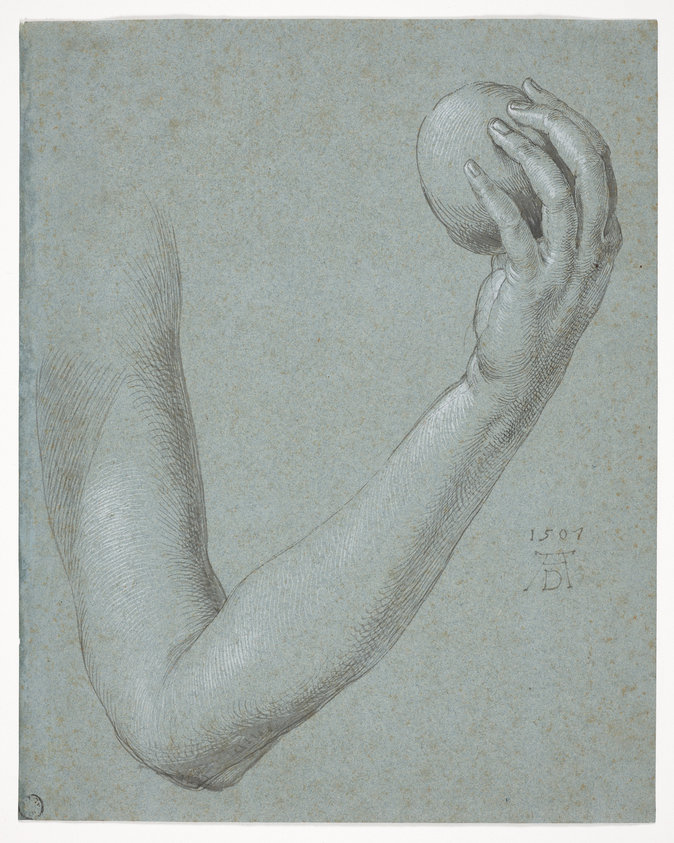
Arm of Eve
Arm of Eve is the only surviving preparatory drawing for Dürer’s life-size panels of Adam and Eve in the Museo del Prado, Madrid. It is also one of the few surviving drawings by the artist made on Venetian blue paper, a support he began to use for his chiaroscuro studies while visiting Venice in the winter of 1506–7. With extraordinary economy of means, using only black and gray ink and a limited amount of wash and gouache for shading and heightening, Dürer suggested the grace and balance of the complete human form in this composition of a disembodied arm and hand. Such a study of a hand in...
Details
- Palette
-
Select a color to find related artworks.
- Medium
- point of brush and gray and black wash, brush and gray and black wash, heightened with white gouache
- Dimensions
- sheet: height 0.344 m, width 0.267 m
- Origin
- Germany, Nuremberg
- Department
- Drawings
- Holding institution
- Cleveland Museum of Art
- Image provider
- cleveland-museum-of-art
- License
- CC0-1.0
- Credit
- Gift of Alan Kennedy
Art Genome Taxonomy
9 tags
Subject Matter
-
Body Parts Both · 99%
The image isolates a bent arm, wrist, and hand, and the catalog explicitly describes the subject as a disembodied arm and hand.
-
Figure Studies Both · 98%
The sheet is a focused study of the human limb and hand; the catalog identifies it as a preparatory study concerned with the ideal proportions of the human form.
Medium and Techniques
-
Drawing Both · 99%
The image visibly consists of contour drawing, hatching, wash, and highlights, while the museum classifies the work as a drawing made with brush and wash.
-
Work on Paper Both · 98%
The artwork is visibly made on a blue-gray paper support, and the catalog identifies it as one of Dürer’s drawings on Venetian blue paper.
-
Chiaroscuro Both · 96%
Dark linear passages and gray washes model the limb against the blue paper, with white gouache used to heighten illuminated areas; the catalog places the work among Dürer’s chiaroscuro studies.
-
Stains/Washes Both · 94%
Gray and black wash is visibly used to build tonal transitions and volume, and the catalog specifies gray and black wash in the medium description.
-
Hatching Visual · 98%
Fine directional strokes and cross-hatching follow the contours of the arm, wrist, palm, and fingers to describe anatomy and volume.
Time Periods
-
16th Century Art Metadata · 99%
The catalog dates the drawing to 1507.
Geographic Regions
-
German Art Metadata · 98%
The catalog identifies Dürer as German and gives Germany, Nuremberg as the place of origin.
Source & rights
Albrecht Dürer (German, 1471–1528). Arm of Eve. Cleveland Museum of Art.