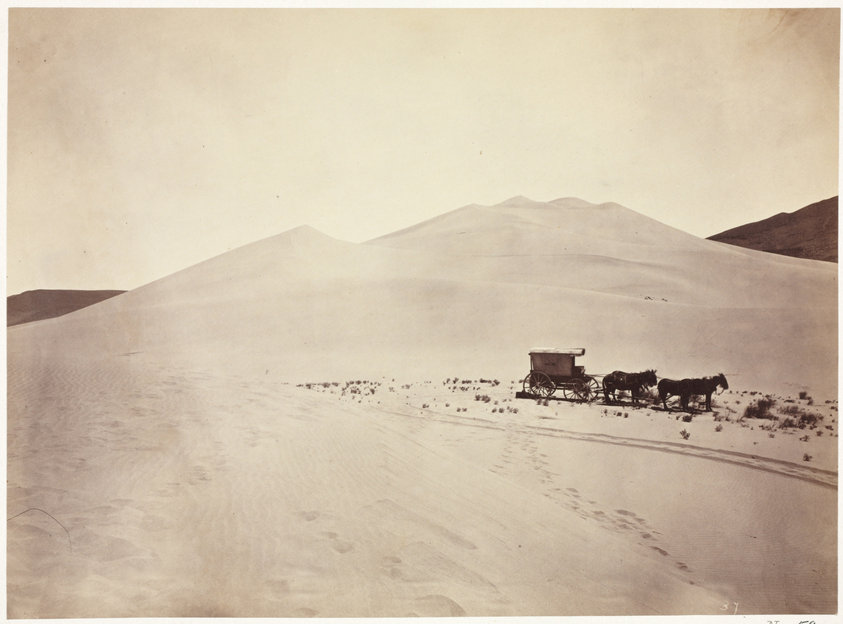
Sand Dunes, Carson Desert, Nevada
This noontime scene conveys a desolate place discovered by a lonely explorer. The artist chose a vantage point and framing that blocked the horizon and showed a single wagon—the former Civil War ambulance that he converted into a portable darkroom—and only two sets of footprints. However, over the previous 25 years, more than 165,000 people had passed near here on their way to California.
Details
- Palette
-
Select a color to find related artworks.
- Dimensions
- image: height 0.197 m, width 0.27 m; mounted: height 0.457 m, width 0.594 m; matted: height 0.508 m, width 0.61 m
- Origin
- America
- Department
- Photography
- Holding institution
- Cleveland Museum of Art
- Image provider
- cleveland-museum-of-art
- License
- CC0-1.0
- Credit
- John L. Severance Fund
Art Genome Taxonomy
11 tags
Subject Matter
-
Landscapes Both · 99%
Sand dunes and desert terrain dominate the composition; the catalog identifies the location as Carson Desert, Nevada.
-
Modes of Transportation Visual · 98%
A horse-drawn wagon occupies the right side of the image; the catalog also identifies a single wagon in the scene.
-
Traces, Indexes, and Implied Presence Visual · 94%
Footprints and wagon tracks are visible in the sand, recording human and vehicular passage without clearly showing people.
Styles and Movements
-
Landscape Photography Both · 97%
The image is composed as a landscape photograph, and the catalog identifies the work as a photograph of the Carson Desert.
Visual Qualities
-
Sparse Visual · 96%
Broad expanses of sand occupy most of the frame, with sparse shrubs and a single wagon providing limited visual interruption.
-
Earth Tones Visual · 94%
The reproduction is dominated by pale beige, sepia, and brown tonalities rather than vivid hues.
Medium and Techniques
-
Photography Both · 99%
The supplied image is a photograph, and the catalog classifies the work as a Photograph and Photography.
-
Long Distance and Deep Distance Visual · 88%
The foreground tracks, middle-ground wagon, overlapping dune planes, and distant ridges create substantial recession into space.
-
Vintage Photo Prints Metadata · 91%
The catalog identifies the object as an albumen print from a wet collodion negative made in 1867.
Time Periods
-
19th Century Art Metadata · 99%
The catalog dates the work to 1867.
Geographic Regions
-
American Art Metadata · 95%
The catalog identifies the artist as American and the place of origin as America.
Source & rights
Timothy H. O'Sullivan (American, 1840–1882). Sand Dunes, Carson Desert, Nevada. Cleveland Museum of Art.